the graph of the function f is given.\n(a) use six rectangles to find estimates of each type for the area…
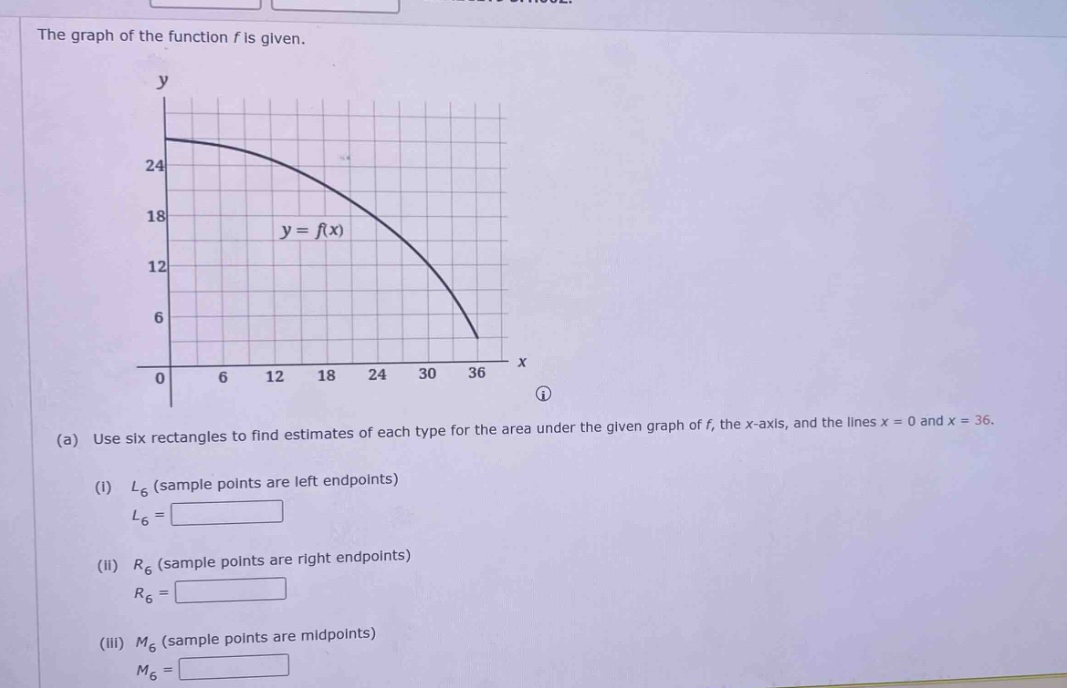
the graph of the function f is given.\n(a) use six rectangles to find estimates of each type for the area under the given graph of f, the x - axis, and the lines x = 0 and x = 36.\n(i) l6 (sample points are left endpoints)\nl6=\n(ii) r6 (sample points are right endpoints)\nr6=\n(iii) m6 (sample points are midpoints)\nm6=
Answer
Explanation:
Step1: Calcular el ancho de cada rectángulo
El intervalo es de $x = 0$ a $x=36$ y $n = 6$. El ancho $\Delta x=\frac{36 - 0}{6}=6$.
Step2: Encontrar los valores de $x$ para los puntos de muestreo
Para $L_6$: $x_0 = 0,x_1=6,x_2 = 12,x_3=18,x_4 = 24,x_5=30$. Para $R_6$: $x_1 = 6,x_2=12,x_3 = 18,x_4=24,x_5 = 30,x_6=36$. Para $M_6$: $x_0 = 3,x_1=9,x_2 = 15,x_3=21,x_4 = 27,x_5=33$.
Step3: Leer los valores de $y = f(x)$ del gráfico
Supongamos que los valores de $y = f(x)$ leídos del gráfico para los puntos correspondientes son: Para $L_6$: $y_0=f(0),y_1=f(6),y_2=f(12),y_3=f(18),y_4=f(24),y_5=f(30)$. Para $R_6$: $y_1=f(6),y_2=f(12),y_3=f(18),y_4=f(24),y_5=f(30),y_6=f(36)$. Para $M_6$: $y_0=f(3),y_1=f(9),y_2=f(15),y_3=f(21),y_4=f(27),y_5=f(33)$.
Step4: Calcular $L_6$
$L_6=\sum_{i = 0}^{5}f(x_i)\Delta x=\Delta x\left[f(0)+f(6)+f(12)+f(18)+f(24)+f(30)\right]$.
Step5: Calcular $R_6$
$R_6=\sum_{i = 1}^{6}f(x_i)\Delta x=\Delta x\left[f(6)+f(12)+f(18)+f(24)+f(30)+f(36)\right]$.
Step6: Calcular $M_6$
$M_6=\sum_{i = 0}^{5}f\left(\frac{x_i+x_{i + 1}}{2}\right)\Delta x=\Delta x\left[f(3)+f(9)+f(15)+f(21)+f(27)+f(33)\right]$. Asumiremos valores leídos del gráfico (por ejemplo, si $f(0)=24,f(6)=22,f(12)=20,f(18)=16,f(24)=10,f(30)=4,f(36)=0,f(3)=23,f(9)=21,f(15)=18,f(21)=13,f(27)=7,f(33)=2$): $L_6=6\times(24 + 22+20+16+10+4)=6\times96 = 576$. $R_6=6\times(22 + 20+16+10+4+0)=6\times72=432$. $M_6=6\times(23 + 21+18+13+7+2)=6\times84 = 504$.
Answer:
(i) $L_6 = 576$ (ii) $R_6 = 432$ (iii) $M_6 = 504$