the graph of which function passes through (0,4) and has a minimum value at $(\frac{3pi}{2},3)$?\n$\\circ\\…
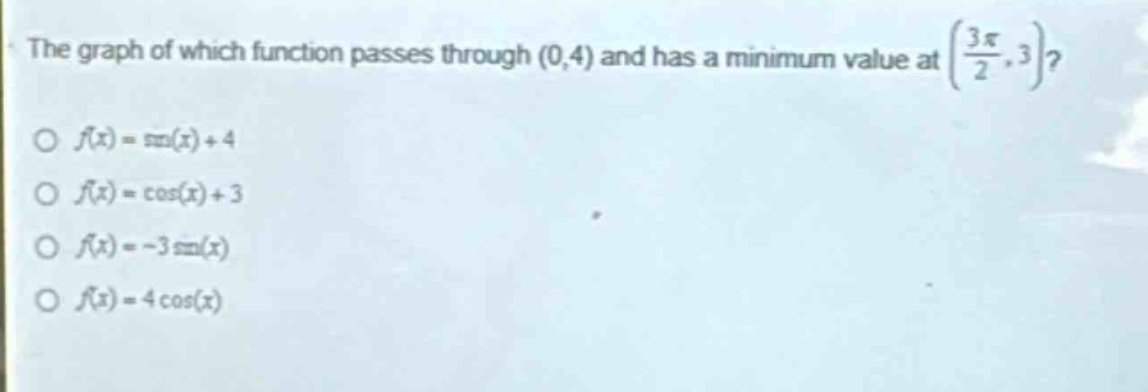
the graph of which function passes through (0,4) and has a minimum value at $(\frac{3pi}{2},3)$?\n$\\circ\\ f(x)=sin(x)+4$\n$\\circ\\ f(x)=cos(x)+3$\n$\\circ\\ f(x)= - 3sin(x)$\n$\\circ\\ f(x)=4cos(x)$
Answer
Answer:
A. $f(x)=\sin(x)+4$
Explanation:
Step1: Check the point $(0,4)$ for each function
- For $y = f(x)=\sin(x)+4$, when $x = 0$, $y=\sin(0)+4=0 + 4=4$.
- For $y = f(x)=\cos(x)+3$, when $x = 0$, $y=\cos(0)+3=1 + 3=4$.
- For $y = f(x)=-3\sin(x)$, when $x = 0$, $y=-3\sin(0)=0$.
- For $y = f(x)=4\cos(x)$, when $x = 0$, $y=4\cos(0)=4\times1 = 4$. So, $y=-3\sin(x)$ is eliminated as it does not pass through $(0,4)$.
Step2: Check the minimum - value point $(\frac{3\pi}{2},3)$ for the remaining functions
- For $y = f(x)=\sin(x)+4$, when $x=\frac{3\pi}{2}$, $y=\sin(\frac{3\pi}{2})+4=-1 + 4=3$.
- For $y = f(x)=\cos(x)+3$, when $x=\frac{3\pi}{2}$, $y=\cos(\frac{3\pi}{2})+3=0 + 3=3$.
- For $y = f(x)=4\cos(x)$, when $x=\frac{3\pi}{2}$, $y=4\cos(\frac{3\pi}{2})=0$. So, $y = 4\cos(x)$ is eliminated.
Step3: Analyze the behavior of the remaining two functions
- The derivative of $y=\sin(x)+4$ is $y'=\cos(x)$. At $x = \frac{3\pi}{2}$, $y'=\cos(\frac{3\pi}{2})=0$. The second - derivative $y''=-\sin(x)$. At $x=\frac{3\pi}{2}$, $y''=-\sin(\frac{3\pi}{2}) = 1>0$, so it has a minimum at $x=\frac{3\pi}{2}$.
- The derivative of $y=\cos(x)+3$ is $y'=-\sin(x)$. At $x=\frac{3\pi}{2}$, $y'=-\sin(\frac{3\pi}{2}) = 1\neq0$, so it does not have a minimum at $x=\frac{3\pi}{2}$.
So the function is $f(x)=\sin(x)+4$.