the graph of which function passes through (0,4) and has a minimum value at $(\frac{3pi}{2},3)$?\n$f(x)=sin(x…
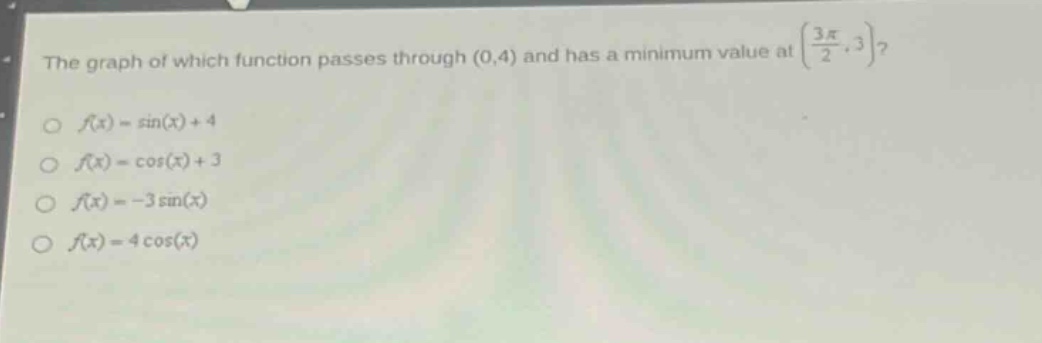
the graph of which function passes through (0,4) and has a minimum value at $(\frac{3pi}{2},3)$?\n$f(x)=sin(x)+4$\n$f(x)=cos(x)+3$\n$f(x)= - 3sin(x)$\n$f(x)=4cos(x)$
Answer
Explanation:
Step1: Check the point (0,4)
Substitute (x = 0) into each function. For (y=\sin(x)+4), when (x = 0), (y=\sin(0)+4=0 + 4=4). For (y=\cos(x)+3), when (x = 0), (y=\cos(0)+3=1 + 3=4). For (y=-3\sin(x)), when (x = 0), (y=-3\sin(0)=0). For (y = 4\cos(x)), when (x = 0), (y=4\cos(0)=4\times1 = 4). So we can't eliminate any function based on the point ((0,4)) yet.
Step2: Check the minimum - point ((\frac{3\pi}{2},3))
For (y=\sin(x)+4), when (x=\frac{3\pi}{2}), (y=\sin(\frac{3\pi}{2})+4=-1 + 4=3). For (y=\cos(x)+3), when (x=\frac{3\pi}{2}), (y=\cos(\frac{3\pi}{2})+3=0 + 3=3). For (y=-3\sin(x)), when (x=\frac{3\pi}{2}), (y=-3\sin(\frac{3\pi}{2})=-3\times(-1)=3). For (y = 4\cos(x)), when (x=\frac{3\pi}{2}), (y=4\cos(\frac{3\pi}{2})=0). So we can eliminate (y = 4\cos(x)).
Step3: Analyze the behavior of remaining functions
The general form of a sine - function is (y = A\sin(Bx - C)+D) and a cosine - function is (y=A\cos(Bx - C)+D). The minimum value of (y = A\sin(Bx - C)+D) is (D - |A|) and the minimum value of (y=A\cos(Bx - C)+D) is (D - |A|). For (y=\sin(x)+4), (A = 1), (D = 4), and the minimum value is (4-1 = 3). For (y=\cos(x)+3), (A = 1), (D = 3), and the minimum value is (3 - 1=2). For (y=-3\sin(x)), (A=-3), (D = 0), and the minimum value is (0-3=-3).
Answer:
(f(x)=\sin(x)+4)