the graph below is the function $f(x)$\nselect all statements below that you agree with.\nnote: you may be…
the graph below is the function $f(x)$\nselect all statements below that you agree with.\nnote: you may be checking more than one box. no partial credit.\n$f(2)$ is defined.\n$lim_{x\rightarrow2}f(x)$ exists.\n$lim_{x\rightarrow2}f(x)=f(2)$.\nthe function is continuous at x = 2.\nthe function is not continuous at x = 2.
Answer
Explanation:
Step1: Check if $f(2)$ is defined
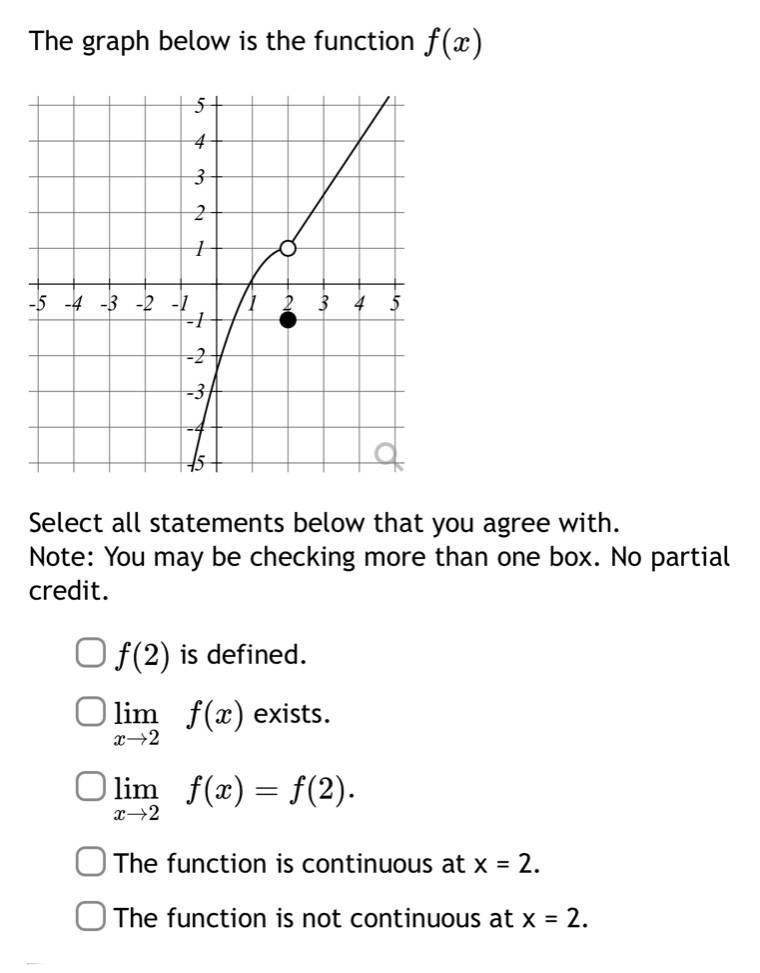
The solid - dot at $x = 2$ on the graph indicates that $f(2)$ has a value. So $f(2)$ is defined.
Step2: Check if $\lim_{x\rightarrow2}f(x)$ exists
As $x$ approaches $2$ from the left and from the right, the function approaches the same $y$ - value (the open - dot value). So $\lim_{x\rightarrow2}f(x)$ exists.
Step3: Check if $\lim_{x\rightarrow2}f(x)=f(2)$
The value of the function at $x = 2$ (solid - dot) is different from the limit value (open - dot) as $x$ approaches $2$. So $\lim_{x\rightarrow2}f(x)\neq f(2)$.
Step4: Check continuity
A function is continuous at $x = a$ if $\lim_{x\rightarrow a}f(x)=f(a)$. Since $\lim_{x\rightarrow2}f(x)\neq f(2)$, the function is not continuous at $x = 2$.
Answer:
$f(2)$ is defined. $\lim_{x\rightarrow2}f(x)$ exists. The function is not continuous at $x = 2$.