1. the graph of the function (f) is shown above, and consists of four line - segments. the function (g) is…
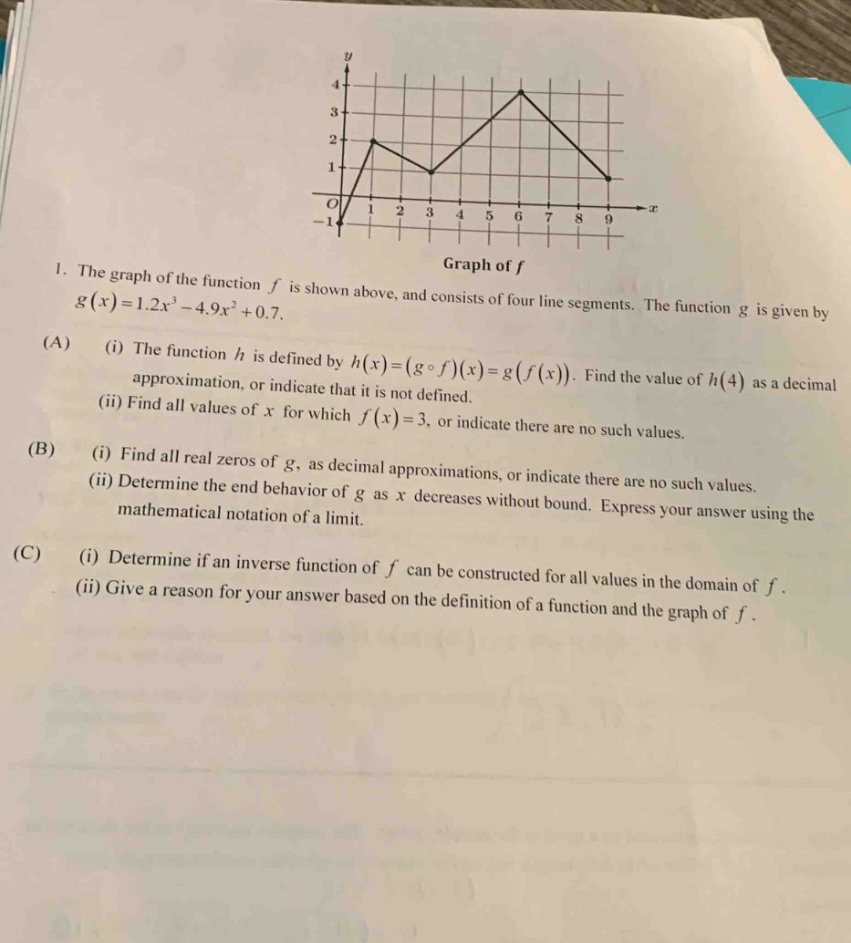
1. the graph of the function (f) is shown above, and consists of four line - segments. the function (g) is given by (g(x)=1.2x^{3}-4.9x^{2}+0.7).\n(a) (i) the function (h) is defined by (h(x)=(gcirc f)(x)=g(f(x))). find the value of (h(4)) as a decimal approximation, or indicate that it is not defined.\n(ii) find all values of (x) for which (f(x)=3), or indicate there are no such values.\n(b) (i) find all real zeros of (g), as decimal approximations, or indicate there are no such values.\n(ii) determine the end - behavior of (g) as (x) decreases without bound. express your answer using the mathematical notation of a limit.\n(c) (i) determine if an inverse function of (f) can be constructed for all values in the domain of (f).\n(ii) give a reason for your answer based on the definition of a function and the graph of (f).
Answer
Explanation:
Step1: Find $f(4)$ from the graph
From the graph of $f$, when $x = 4$, $f(4)=2$.
Step2: Calculate $h(4)$
Since $h(x)=g(f(x))$, when $x = 4$, $h(4)=g(f(4))$. Substitute $f(4)=2$ into $g(x)=1.2x^{3}-4.9x^{2}+0.7$. Then $g(2)=1.2\times2^{3}-4.9\times2^{2}+0.7=1.2\times8 - 4.9\times4+0.7=9.6-19.6 + 0.7=-9.3$.
Step3: Find $x$ for $f(x)=3$
From the graph of $f$, we can see that $f(x)=3$ when $x = 6$.
Step4: Find zeros of $g(x)$
Set $g(x)=1.2x^{3}-4.9x^{2}+0.7 = 0$. We can use a graph - ing utility or a numerical method like Newton - Raphson method. Using a graphing calculator, the real zeros of $g(x)$ are approximately $x\approx0.41,x\approx3.77$.
Step5: Determine end - behavior of $g(x)$ as $x\to-\infty$
For the polynomial function $g(x)=1.2x^{3}-4.9x^{2}+0.7$, since the leading term is $1.2x^{3}$ and the coefficient of the leading term $a = 1.2>0$ and the degree $n = 3$ (odd), $\lim_{x\to-\infty}g(x)=-\infty$.
Step6: Check if inverse of $f$ exists
An inverse function of $f$ cannot be constructed for all values in the domain of $f$.
Step7: Give reason
A function has an inverse if and only if it is one - to - one. From the graph of $f$, the horizontal line test fails. For example, there are multiple $x$ values that give the same $y$ value (e.g., $y = 1$ has multiple $x$ values in the domain of $f$), so $f$ is not one - to - one.
Answer:
(A)(i) $h(4)=-9.3$ (A)(ii) $x = 6$ (B)(i) $x\approx0.41,x\approx3.77$ (B)(ii) $\lim_{x\to-\infty}g(x)=-\infty$ (C)(i) No (C)(ii) $f$ is not one - to - one as it fails the horizontal line test.