the graph of the function f(x) is shown below. a function labeled f of x passes through (-4, -5), (-2, -4)…
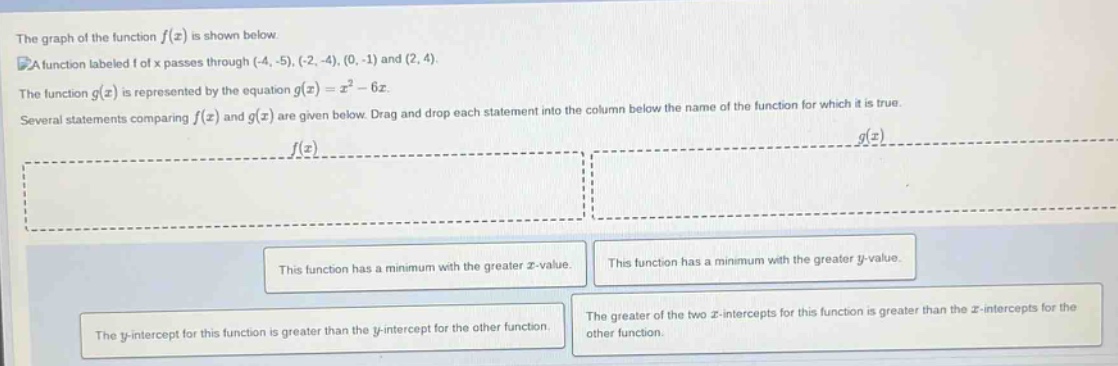
the graph of the function f(x) is shown below. a function labeled f of x passes through (-4, -5), (-2, -4), (0, -1) and (2, 4). the function g(x) is represented by the equation g(x)=x² - 6x. several statements comparing f(x) and g(x) are given below. drag and drop each statement into the column below the name of the function for which it is true. f(x) g(x) this function has a minimum with the greater x - value. this function has a minimum with the greater y - value. the y - intercept for this function is greater than the y - intercept for the other function. the greater of the two x - intercepts for this function is greater than the x - intercepts for the other function.
Answer
Explanation:
Step1: Find the y - intercept of (f(x))
The function (f(x)) passes through ((0, - 1)), so the y - intercept of (f(x)) is (y=-1).
Step2: Find the y - intercept of (g(x))
For (g(x)=x^{2}-6x), when (x = 0), (g(0)=0^{2}-6\times0 = 0). Since (0>-1), the y - intercept of (g(x)) is greater than the y - intercept of (f(x)).
Step3: Rewrite (g(x)) in vertex - form
(g(x)=x^{2}-6x=(x - 3)^{2}-9). The vertex of (g(x)) is ((3,-9)), so the x - value of the minimum of (g(x)) is (x = 3) and the y - value of the minimum of (g(x)) is (y=-9). For (f(x)), we can't be sure of the exact minimum from the given points, but we know (f(-4)=-5,f(-2)=-4,f(0)=-1,f(2)=4). It seems (f(x)) is increasing on the interval ([-4,2]) and we assume the minimum of (f(x)) among these points is (y=-5) at (x=-4). So (f(x)) has a minimum with a greater y - value. And (g(x)) has a minimum with a greater x - value.
Step4: Find the x - intercepts of (g(x))
Set (g(x)=x^{2}-6x=x(x - 6)=0). The x - intercepts of (g(x)) are (x = 0) and (x = 6). We don't have enough information to find the x - intercepts of (f(x)) precisely from the given points, but since the greater x - intercept of (g(x)) is (x = 6), and we have no evidence that (f(x)) has an x - intercept greater than (6), the greater of the two x - intercepts for (g(x)) is greater than the x - intercepts for (f(x)) (as far as we know).
Answer:
| Statement | (f(x)) | (g(x)) |
|---|---|---|
| This function has a minimum with the greater x - value. | (g(x)) | |
| This function has a minimum with the greater y - value. | (f(x)) | |
| The y - intercept for this function is greater than the y - intercept for the other function. | (g(x)) | |
| The greater of the two x - intercepts for this function is greater than the x - intercepts for the other function. | (g(x)) |