the graph of function f is shown below. let h(x)=∫_{-4}^{x}f(t)dt. evaluate h(-2). h(-2)=
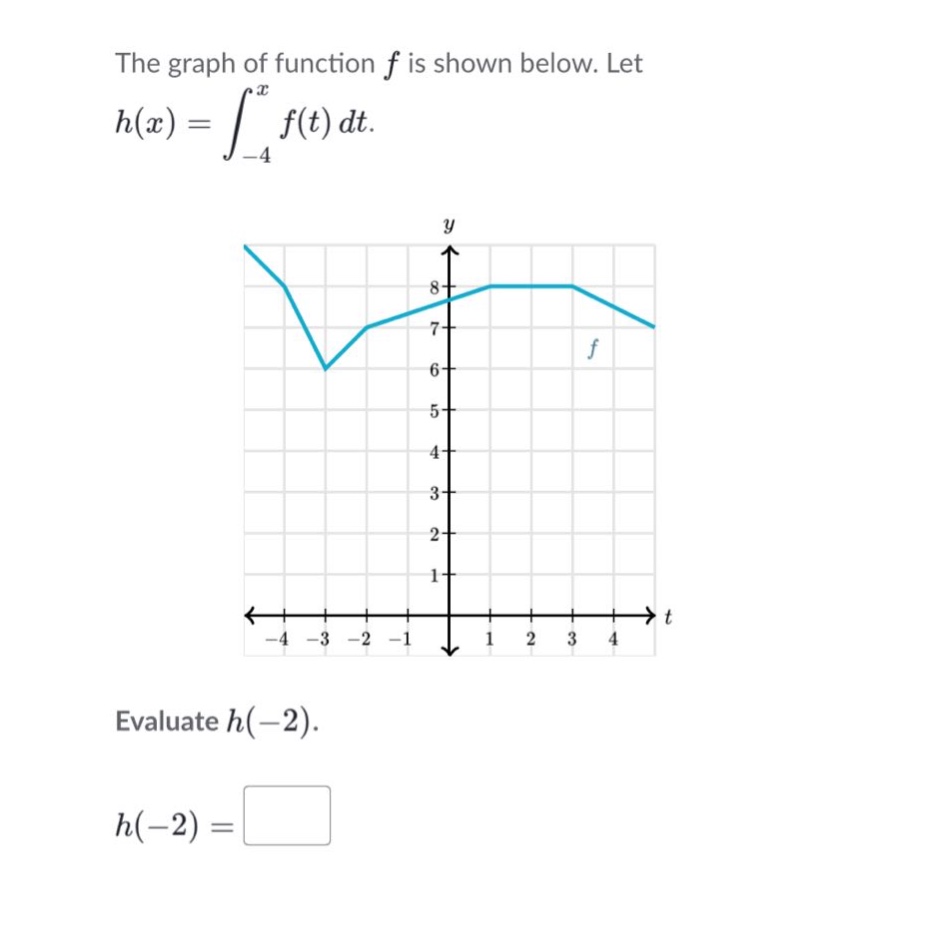
the graph of function f is shown below. let h(x)=∫_{-4}^{x}f(t)dt. evaluate h(-2). h(-2)=
Answer
Explanation:
Step1: Recall the definition of $h(x)$
$h(-2)=\int_{-4}^{-2}f(t)dt$. This integral represents the net - signed area between the curve $y = f(t)$ and the $t$-axis from $t=-4$ to $t = - 2$.
Step2: Calculate the area using geometric shapes
We can approximate the area between the curve $y = f(t)$ and the $t$-axis from $t=-4$ to $t=-2$ as a trapezoid. The formula for the area of a trapezoid is $A=\frac{1}{2}(b_1 + b_2)h$. The vertical distances (heights of the trapezoid) at $t=-4$ and $t=-2$ can be read from the graph. Let's assume the value of $f(-4)=8$ and $f(-2)=6$. The base of the trapezoid $h=-2-(-4)=2$. Using the area formula for a trapezoid $A=\frac{1}{2}(8 + 6)\times2$.
Step3: Simplify the expression
$A=\frac{1}{2}(14)\times2=14$.
Answer:
$14$