the graph of the function f is shown above. let g be the function defined by g(x)=∫₁ˣ f(t)dt. at what values…
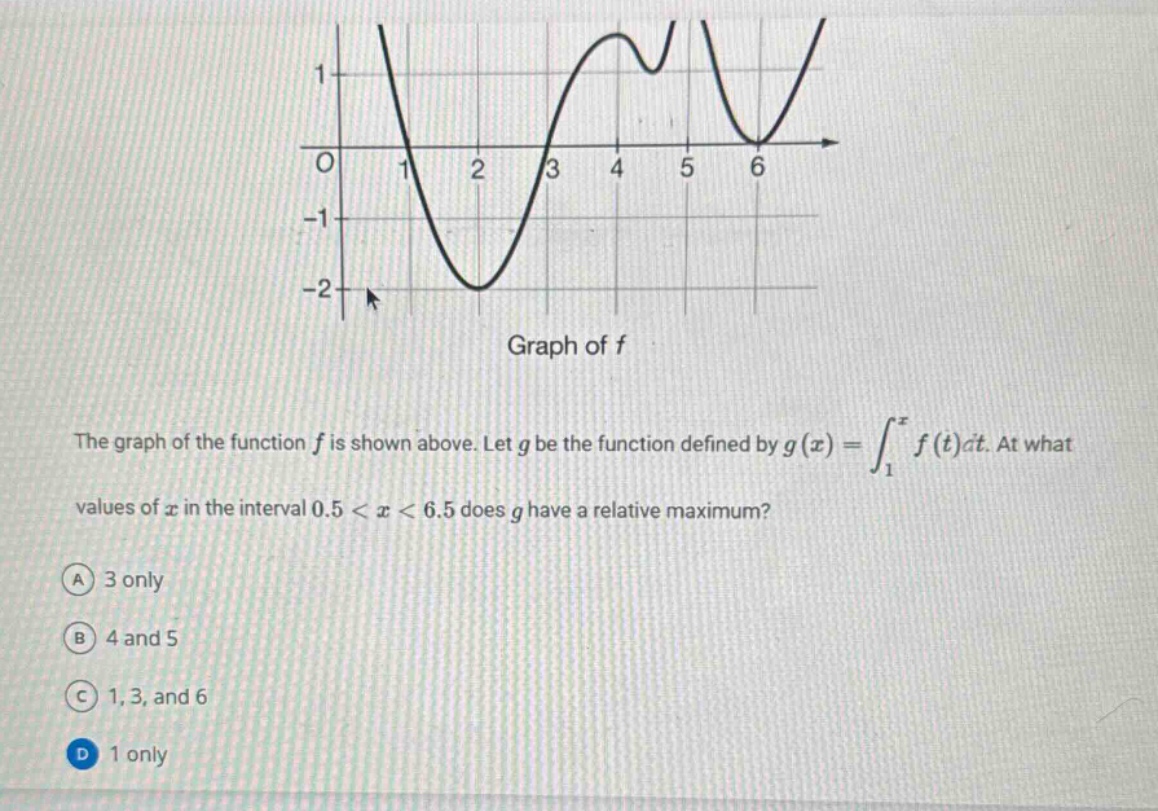
the graph of the function f is shown above. let g be the function defined by g(x)=∫₁ˣ f(t)dt. at what values of x in the interval 0.5 < x < 6.5 does g have a relative maximum? a 3 only b 4 and 5 c 1, 3, and 6 d 1 only
Answer
Explanation:
Step1: Recall the fundamental theorem of calculus
By the fundamental - theorem of calculus, if (g(x)=\int_{1}^{x}f(t)dt), then (g^\prime(x) = f(x)).
Step2: Use the first - derivative test for extrema
A function (y = g(x)) has a relative maximum at a point (c) in its domain if (g^\prime(x)) changes sign from positive to negative at (x = c). That is, (g^\prime(x)>0) for (x) slightly less than (c) and (g^\prime(x)<0) for (x) slightly greater than (c). Since (g^\prime(x)=f(x)), we need to find where (f(x)) changes sign from positive to negative in the interval (0.5 < x<6.5).
Step3: Analyze the sign of (f(x)) from the graph
Looking at the graph of (y = f(x)):
- For (x\in(0.5,1)), (f(x)<0).
- For (x\in(1,3)), (f(x)<0).
- For (x\in(3,4)), (f(x)>0).
- For (x\in(4,5)), (f(x)>0).
- For (x\in(5,6)), (f(x)<0).
- For (x\in(6,6.5)), (f(x)>0). The function (f(x)) changes sign from positive to negative at (x = 5). Also, at (x = 1), although the graph starts from the left - hand side of (x = 1) with (f(x)<0) and we are considering the open interval ((0.5,6.5)), if we think about the behavior of (g(x)) based on the integral, (g(x)) has a relative maximum at (x = 1) because the integral (\int_{1}^{x}f(t)dt) starts accumulating negative values as (x) moves from (1) to (3).
Answer:
D. 1 only