graph the function.\ny = 2 tan 4x\n\na.\nb.\nc.\nd.
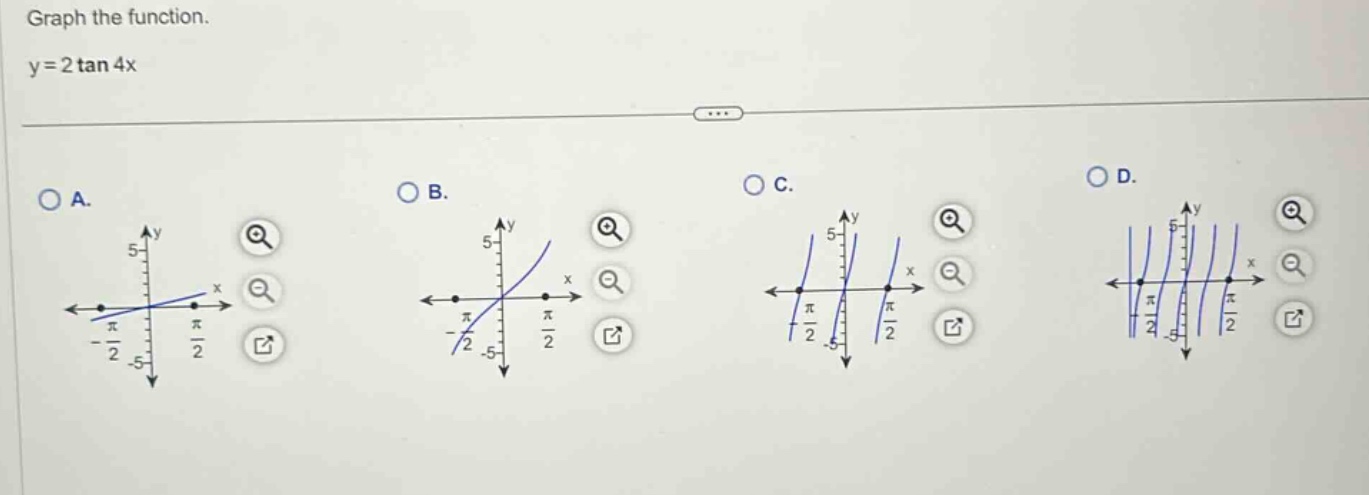
graph the function.\ny = 2 tan 4x\n\na.\nb.\nc.\nd.
Answer
Explanation:
Step1: Recall the properties of the tangent - function
The general form of the tangent function is $y = A\tan(Bx - C)+D$. For the function $y = 2\tan(4x)$, we have $A = 2$, $B = 4$, $C = 0$, and $D = 0$. The period of the tangent function $y=\tan x$ is $\pi$. The period of $y = A\tan(Bx)$ is given by $\frac{\pi}{|B|}$. So, the period of $y = 2\tan(4x)$ is $\frac{\pi}{4}$.
Step2: Find the vertical asymptotes
The vertical asymptotes of the tangent function $y=\tan x$ occur at $x=(n+\frac{1}{2})\pi$, where $n\in\mathbb{Z}$. For the function $y = 2\tan(4x)$, the vertical asymptotes occur when $4x=(n +\frac{1}{2})\pi$. Solving for $x$, we get $x=\frac{(2n + 1)\pi}{8}$, $n\in\mathbb{Z}$.
Step3: Analyze the amplitude
The coefficient $A = 2$ in $y = 2\tan(4x)$ stretches the graph of $y=\tan(4x)$ vertically by a factor of 2. When $x = 0$, $y=2\tan(0)=0$.
The graph of $y = 2\tan(4x)$ has a period of $\frac{\pi}{4}$, vertical asymptotes at $x=\frac{(2n + 1)\pi}{8}$, $n\in\mathbb{Z}$, and passes through the origin.
Answer:
(Without seeing the specific details of each option precisely, we can eliminate options based on the above - derived properties. The correct graph should have a period of $\frac{\pi}{4}$, vertical asymptotes at $x=\frac{(2n + 1)\pi}{8}$, $n\in\mathbb{Z}$, and pass through the origin. You need to check which of the given graphs A, B, C, D satisfies these properties.)