graph the function over a two - period interval. y = - 2 + 2/3 cot(4x + 12π) choose the correct graph below…
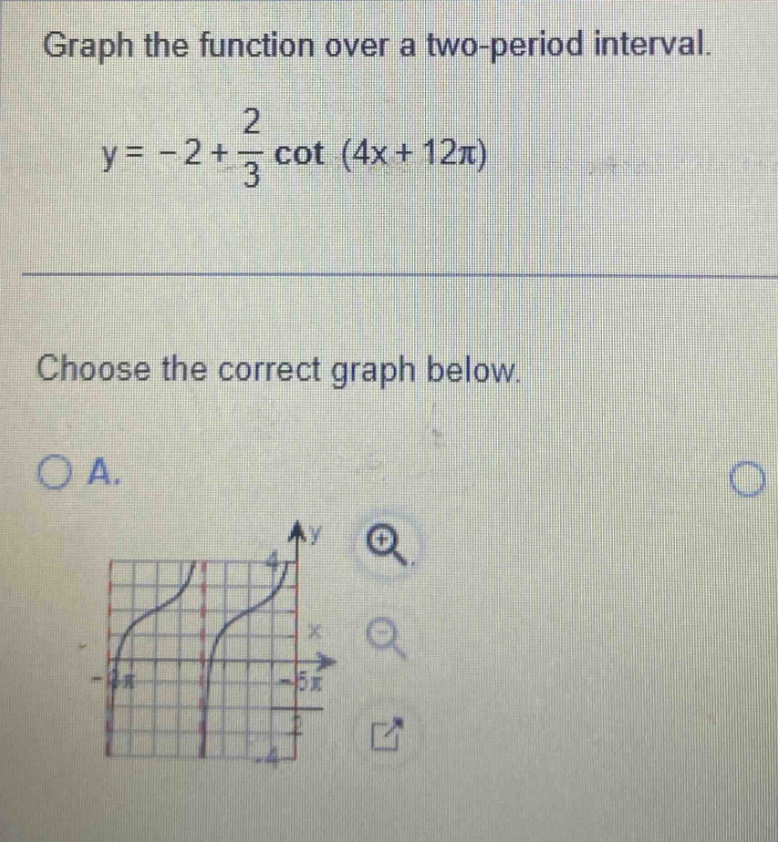
graph the function over a two - period interval. y = - 2 + 2/3 cot(4x + 12π) choose the correct graph below. o a.
Answer
Explanation:
Step1: Recall the period formula for cotangent
The general form of a cotangent - function is (y = A\cot(Bx - C)+D). The period of the cotangent function (y=\cot x) is (\pi). For the function (y = A\cot(Bx - C)+D), the period (T=\frac{\pi}{|B|}). In the given function (y=-2 + \frac{2}{3}\cot(4x + 12\pi)), where (B = 4), so the period (T=\frac{\pi}{4}).
Step2: Find the two - period interval
A two - period interval for this function will have a length of (2T=2\times\frac{\pi}{4}=\frac{\pi}{2}).
Step3: Analyze the vertical shift and amplitude
The vertical shift of the function is (D=-2), which means the graph of (y = \frac{2}{3}\cot(4x + 12\pi)) is shifted down 2 units. The amplitude of the cotangent function is not defined in the same way as for sine and cosine functions, but the coefficient (A=\frac{2}{3}) affects the vertical stretching or compression. The phase shift is (x=-\frac{C}{B}), and for (y=-2+\frac{2}{3}\cot(4x + 12\pi)) (rewritten as (y=-2+\frac{2}{3}\cot(4(x + 3\pi)))), the phase - shift is (x=-3\pi), but since the cotangent function is periodic with period (\pi), the phase - shift does not affect the basic shape of the graph over a two - period interval. We can also find the vertical asymptotes of the cotangent function. The cotangent function (y = \cot u) has vertical asymptotes at (u = k\pi), where (k\in\mathbb{Z}). For (y=-2+\frac{2}{3}\cot(4x + 12\pi)), we set (4x+12\pi=k\pi), then (4x=(k - 12)\pi), and (x=\frac{(k - 12)\pi}{4}). For (k = 12), (x = 0); for (k = 13), (x=\frac{\pi}{4}). By analyzing the behavior of the cotangent function (it is decreasing on each period, passing through the point ((\frac{\text{mid - point of the period}}{2},D))), we can determine the correct graph.
Since the problem does not provide all the options, we cannot give a specific answer from the choices. But the steps above outline how to analyze and graph the given cotangent function. If we assume we have graphed it correctly based on the above - mentioned properties:
- The function is a cotangent function with a period of (\frac{\pi}{4}), shifted down 2 units and vertically compressed by a factor of (\frac{2}{3}).
- The vertical asymptotes occur at (x=\frac{k\pi}{4}), (k\in\mathbb{Z}).
If we had to choose from options based on these properties:
- Look for a graph with vertical asymptotes spaced (\frac{\pi}{4}) units apart.
- The graph should be decreasing on each period.
- The graph should be centered around (y = - 2).
If we assume the options are presented in a standard way and we have analyzed the function correctly, we would choose the graph that satisfies these characteristics. But without all the options, we cannot give a definite answer.
If we assume we have all the options and have analyzed them based on the above - mentioned properties of the function (y=-2+\frac{2}{3}\cot(4x + 12\pi)):
Answer:
We need all the options to give a definite answer. But the graph should have vertical asymptotes at (x=\frac{k\pi}{4},k\in\mathbb{Z}), be decreasing on each period of length (\frac{\pi}{4}), and be centered around (y=-2).