graph the function. use the graph of f(x)=e^x to obtain the graph of g(x)=e^x - 2. a. b. c. d.
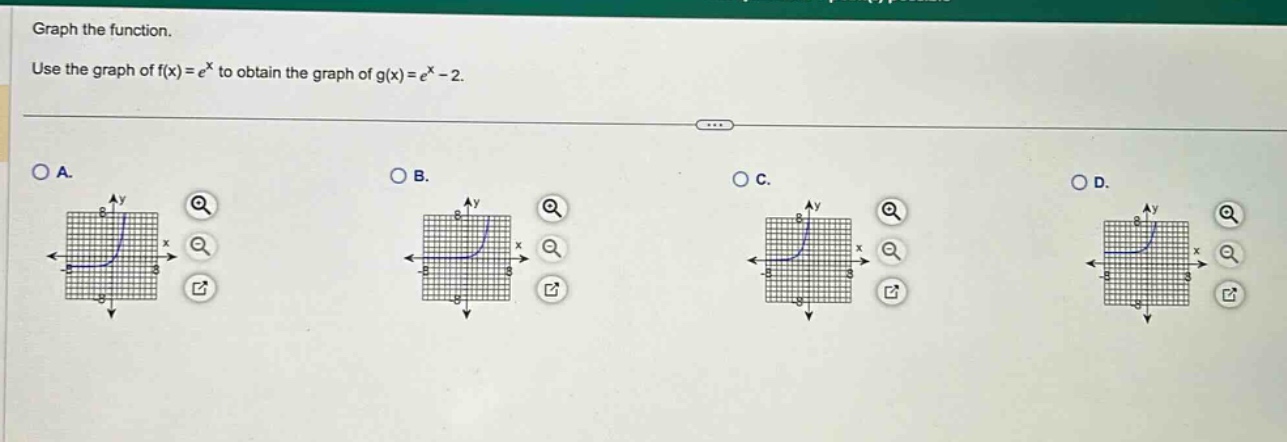
graph the function. use the graph of f(x)=e^x to obtain the graph of g(x)=e^x - 2. a. b. c. d.
Answer
Explanation:
Step1: Recall transformation rule
The transformation from $y = f(x)$ to $y=f(x)-k$ (where $k > 0$) is a vertical - shift downwards by $k$ units. Here, $f(x)=e^{x}$ and $g(x)=e^{x}-2$, so the graph of $y = e^{x}$ is shifted down 2 units.
Step2: Analyze key - points
The graph of $y = e^{x}$ passes through the point $(0,1)$ since $e^{0}=1$. For the function $g(x)=e^{x}-2$, when $x = 0$, $g(0)=e^{0}-2=1 - 2=-1$. So the graph of $g(x)$ passes through the point $(0, - 1)$.
Answer:
The graph of $g(x)=e^{x}-2$ is the graph of $f(x)=e^{x}$ shifted down 2 units. Without seeing the actual details of the graphs A, B, C, D, if we assume the standard exponential - function shape, the correct graph is the one where the exponential curve of $y = e^{x}$ is shifted down 2 units such that its $y$ - intercept is at $(0,-1)$.