3. here is the graph of a function for some values of x. a. can you extend the graph to the whole plane so…
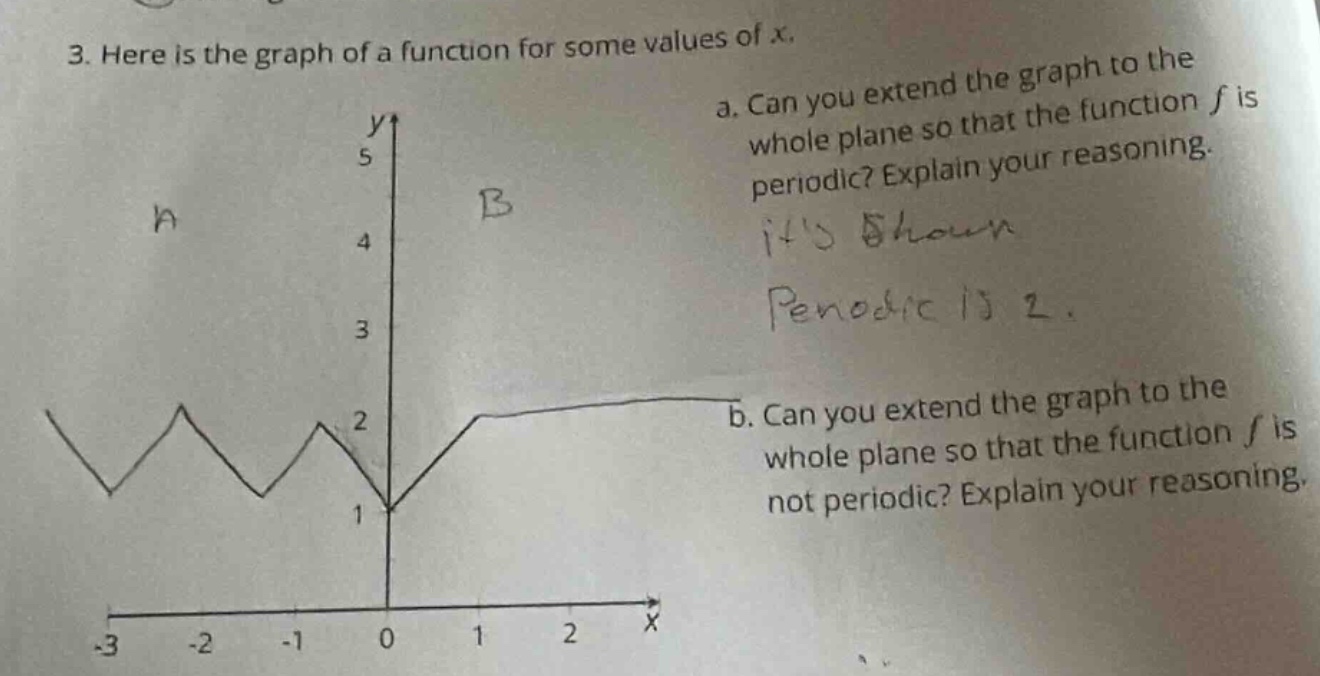
3. here is the graph of a function for some values of x. a. can you extend the graph to the whole plane so that the function f is periodic? explain your reasoning. its shown periodic is 2. b. can you extend the graph to the whole plane so that the function f is not periodic? explain your reasoning.
Answer
Explanation:
Step1: Recall periodic - function definition
A function (y = f(x)) is periodic with period (T\neq0) if (f(x + T)=f(x)) for all (x) in the domain of (f).
Step2: Analyze part a
Since the graph on the left - hand side of the (y) - axis shows a pattern that repeats with a period of (2) (the shape of the graph from (x=-2) to (x = 0) is the same as from (x=-4) to (x=-2) etc.), we can extend the graph to the whole plane by repeating this pattern. For any (x) value, we can find (f(x + 2)=f(x)) based on the existing pattern.
Step3: Analyze part b
To make the function non - periodic, we can define the function for (x\geq0) in a non - repeating way. For example, we can make the function a linear function for (x\geq0) such as (f(x)=x + 1) for (x\geq0). Then, for (x_1) and (x_2), (f(x_1+T)\neq f(x_1)) for any non - zero (T) when considering the behavior of the linear part and the periodic part together.
Answer:
a. Yes. The existing part of the graph on the left - hand side of the (y) - axis shows a periodic pattern with period (2). We can repeat this pattern for all (x\in(-\infty,\infty)). b. Yes. We can define the function for (x\geq0) in a non - repeating way, such as a linear function, so that the overall function on the whole plane is non - periodic.