3. a. graph the function f(x)=e^x on the window -5,5 by -10,30. b. find f(1), f(-4), and f(5), rounded to…
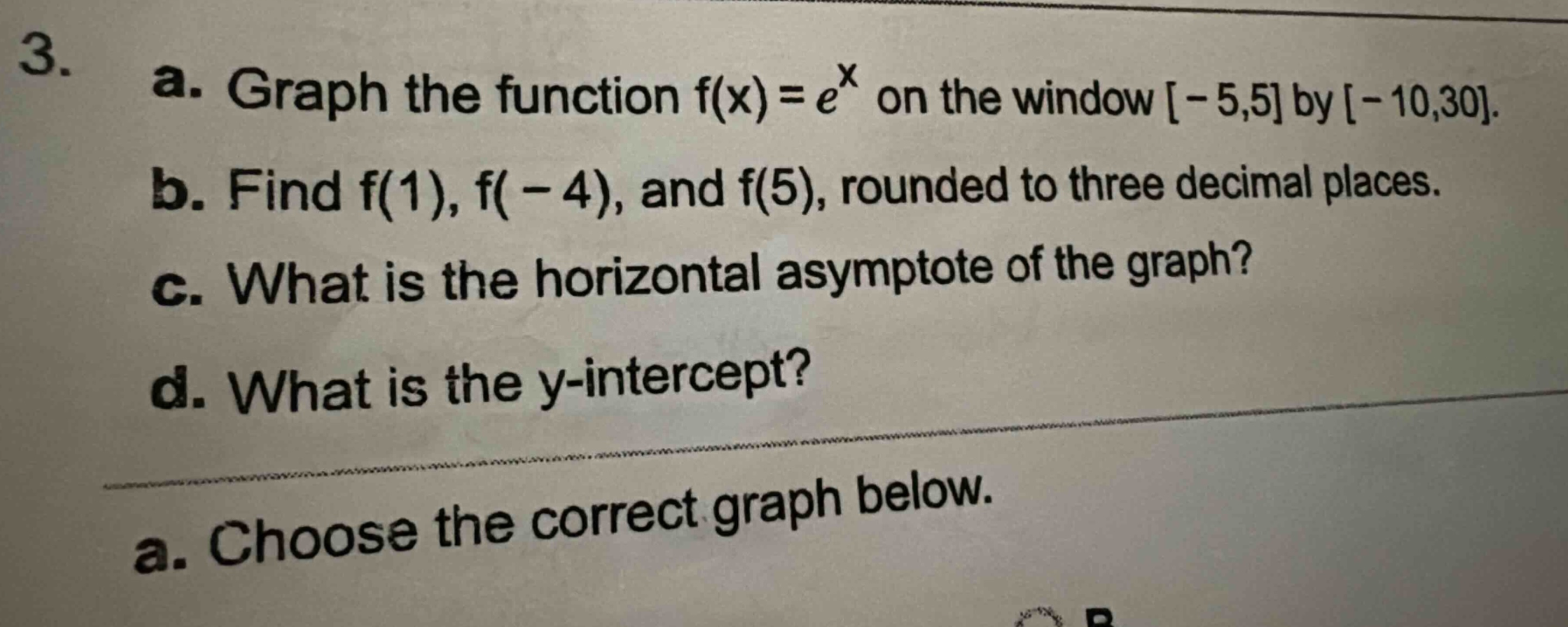
3. a. graph the function f(x)=e^x on the window -5,5 by -10,30. b. find f(1), f(-4), and f(5), rounded to three decimal places. c. what is the horizontal asymptote of the graph? d. what is the y - intercept? a. choose the correct graph below.
Answer
Explanation:
Step1: Recall the exponential - function properties
The function (y = e^{x}) is an exponential function with base (e\approx2.71828). To graph it, we can use a graphing utility or plot some points.
Step2: Calculate function values
For (f(1)):
Substitute (x = 1) into (f(x)=e^{x}), so (f(1)=e^{1}\approx2.718).
For (f(-4)):
Substitute (x=-4) into (f(x)=e^{x}), then (f(-4)=e^{-4}=\frac{1}{e^{4}}\approx\frac{1}{54.598}\approx0.018).
For (f(5)):
Substitute (x = 5) into (f(x)=e^{x}), so (f(5)=e^{5}\approx148.413).
Step3: Find the horizontal asymptote
As (x\to-\infty), (y = e^{x}\to0). So the horizontal asymptote is (y = 0).
Step4: Find the y - intercept
Set (x = 0) in (y=e^{x}). Then (y=e^{0}=1). So the y - intercept is (1).
Answer:
b. (f(1)\approx2.718), (f(-4)\approx0.018), (f(5)\approx148.413) c. (y = 0) d. (1) (Note: Since no graphs are provided for part a, we cannot choose the correct graph as required in the last part of the problem - statement. But the other parts are solved as above.)