(a) graph the given function, (b) find all values of x where the function is discontinuous, and (c) find the…
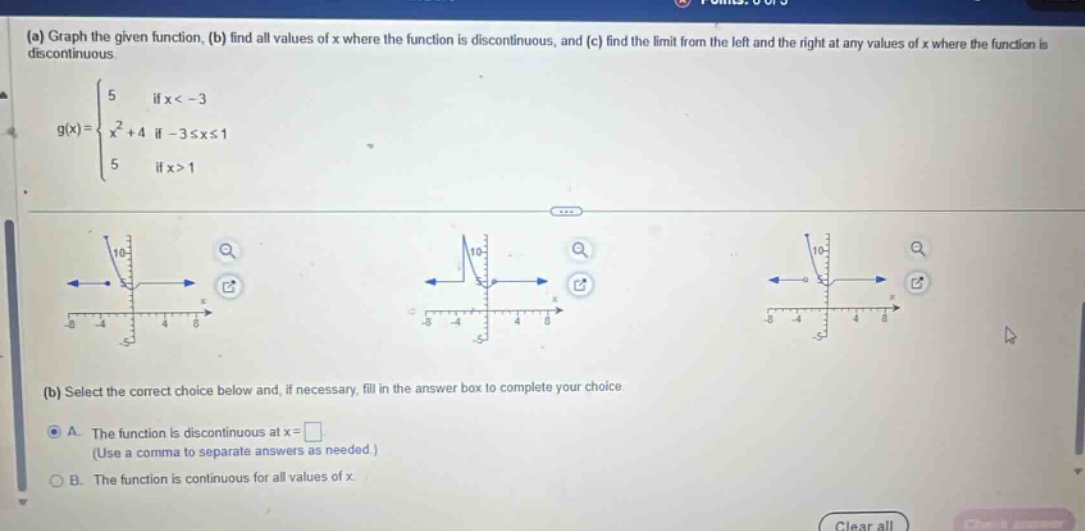
(a) graph the given function, (b) find all values of x where the function is discontinuous, and (c) find the limit from the left and the right at any values of x where the function is discontinuous.\ng(x) = { 5 if x < -3; x² + 4 if -3 ≤ x ≤ 1; 5 if x > 1 }\n(b) select the correct choice below and, if necessary, fill in the answer box to complete your choice.\na. the function is discontinuous at x = \n(use a comma to separate answers as needed.)\nb. the function is continuous for all values of x
Answer
Explanation:
Step1: Analyze continuity at x = - 3
Check left - hand limit $\lim_{x\rightarrow - 3^{-}}g(x)$ and right - hand limit $\lim_{x\rightarrow - 3^{+}}g(x)$. $\lim_{x\rightarrow - 3^{-}}g(x)=5$ (since $g(x) = 5$ for $x < - 3$), $\lim_{x\rightarrow - 3^{+}}g(x)=(-3)^{2}+4=9 + 4=13$. Since $\lim_{x\rightarrow - 3^{-}}g(x)\neq\lim_{x\rightarrow - 3^{+}}g(x)$, the function is discontinuous at $x=-3$.
Step2: Analyze continuity at x = 1
Check left - hand limit $\lim_{x\rightarrow 1^{-}}g(x)$ and right - hand limit $\lim_{x\rightarrow 1^{+}}g(x)$. $\lim_{x\rightarrow 1^{-}}g(x)=1^{2}+4=5$ (since $g(x)=x^{2}+4$ for $-3\leq x\leq1$), $\lim_{x\rightarrow 1^{+}}g(x)=5$ (since $g(x) = 5$ for $x>1$). Since $\lim_{x\rightarrow 1^{-}}g(x)=\lim_{x\rightarrow 1^{+}}g(x)=5$, the function is continuous at $x = 1$.
Step3: Find left - hand and right - hand limits at x=-3
Left - hand limit at $x=-3$: $\lim_{x\rightarrow - 3^{-}}g(x)=5$. Right - hand limit at $x=-3$: $\lim_{x\rightarrow - 3^{+}}g(x)=(-3)^{2}+4 = 13$.
Answer:
(b) A. The function is discontinuous at $x=-3$ (c) At $x=-3$, $\lim_{x\rightarrow - 3^{-}}g(x)=5$, $\lim_{x\rightarrow - 3^{+}}g(x)=13$