graph the given function f(x) over the interval -4π,4π. determine whether the function is periodic and, if…
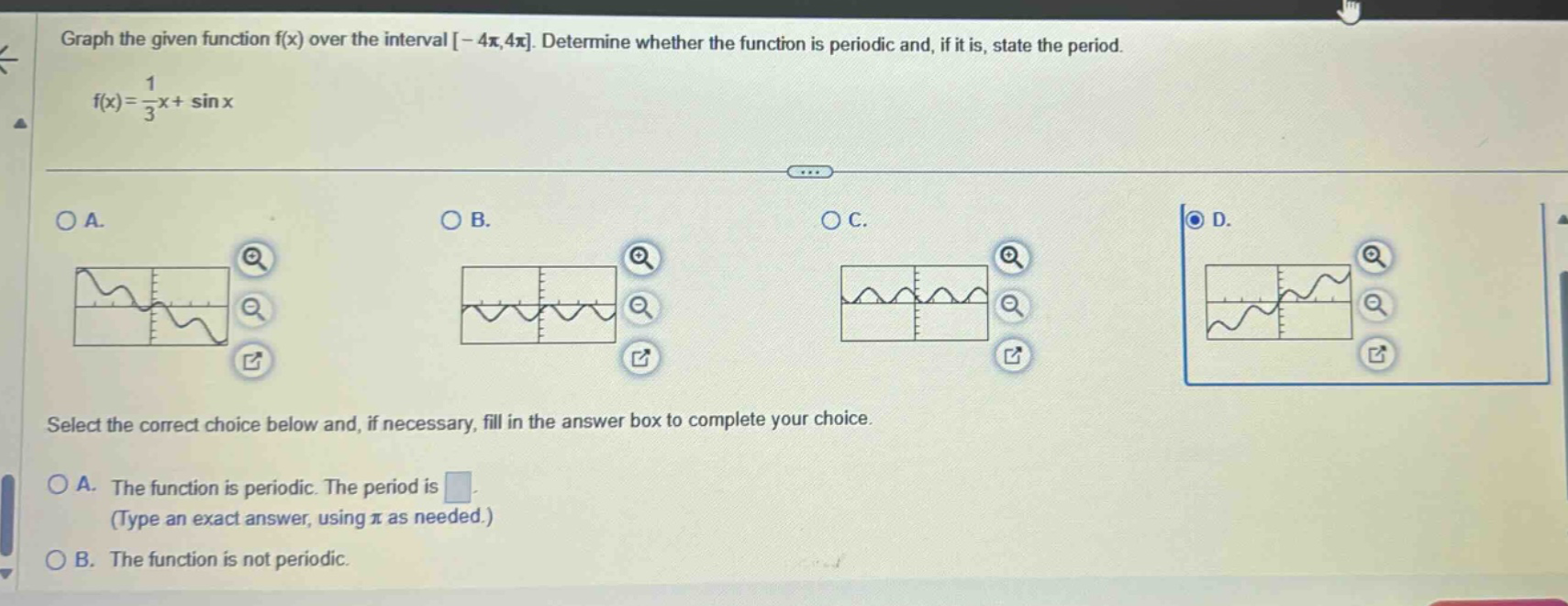
graph the given function f(x) over the interval -4π,4π. determine whether the function is periodic and, if it is, state the period. f(x)=1/3x + sin x select the correct choice below and, if necessary, fill in the answer box to complete your choice. a. the function is periodic. the period is (type an exact answer, using π as needed.) b. the function is not periodic.
Answer
Explanation:
Step1: Recall periodic - function definition
A function (y = f(x)) is periodic if there exists a positive number (T) such that (f(x + T)=f(x)) for all (x) in the domain of (f). Let (f(x)=\frac{1}{3}x+\sin x). Assume (f(x + T)=f(x)), then (\frac{1}{3}(x + T)+\sin(x + T)=\frac{1}{3}x+\sin x).
Step2: Expand the left - hand side
Expanding (\frac{1}{3}(x + T)+\sin(x + T)) gives (\frac{1}{3}x+\frac{1}{3}T+\sin(x + T)). So, (\frac{1}{3}x+\frac{1}{3}T+\sin(x + T)=\frac{1}{3}x+\sin x), which simplifies to (\frac{1}{3}T+\sin(x + T)-\sin x = 0).
Step3: Use the trigonometric identity (\sin(A + B)=\sin A\cos B+\cos A\sin B)
(\sin(x + T)=\sin x\cos T+\cos x\sin T). Then (\frac{1}{3}T+\sin x\cos T+\cos x\sin T-\sin x = 0). Rearranging terms, we get (\frac{1}{3}T+(\cos T - 1)\sin x+\sin T\cos x = 0). Since this equation must hold for all (x), we consider the coefficients of (\sin x) and (\cos x) and the constant term. The coefficient of (\cos x) is (\sin T = 0), so (T = k\pi), (k\in\mathbb{Z}). If (T = k\pi), then the coefficient of (\sin x) is (\cos T - 1). When (T = k\pi), (\cos T=(- 1)^k). If (k\neq0), (\cos T - 1\neq0) for non - zero (k). And the term (\frac{1}{3}T) also depends on (T). The only way for (\frac{1}{3}T+(\cos T - 1)\sin x+\sin T\cos x = 0) to hold for all (x) is when (T = 0). But by the definition of a periodic function, (T>0). So the function (y=\frac{1}{3}x+\sin x) is not periodic.
Answer:
B. The function is not periodic.