graph the given function f(x) over the interval -4π, 4π. determine whether the function is periodic and, if…
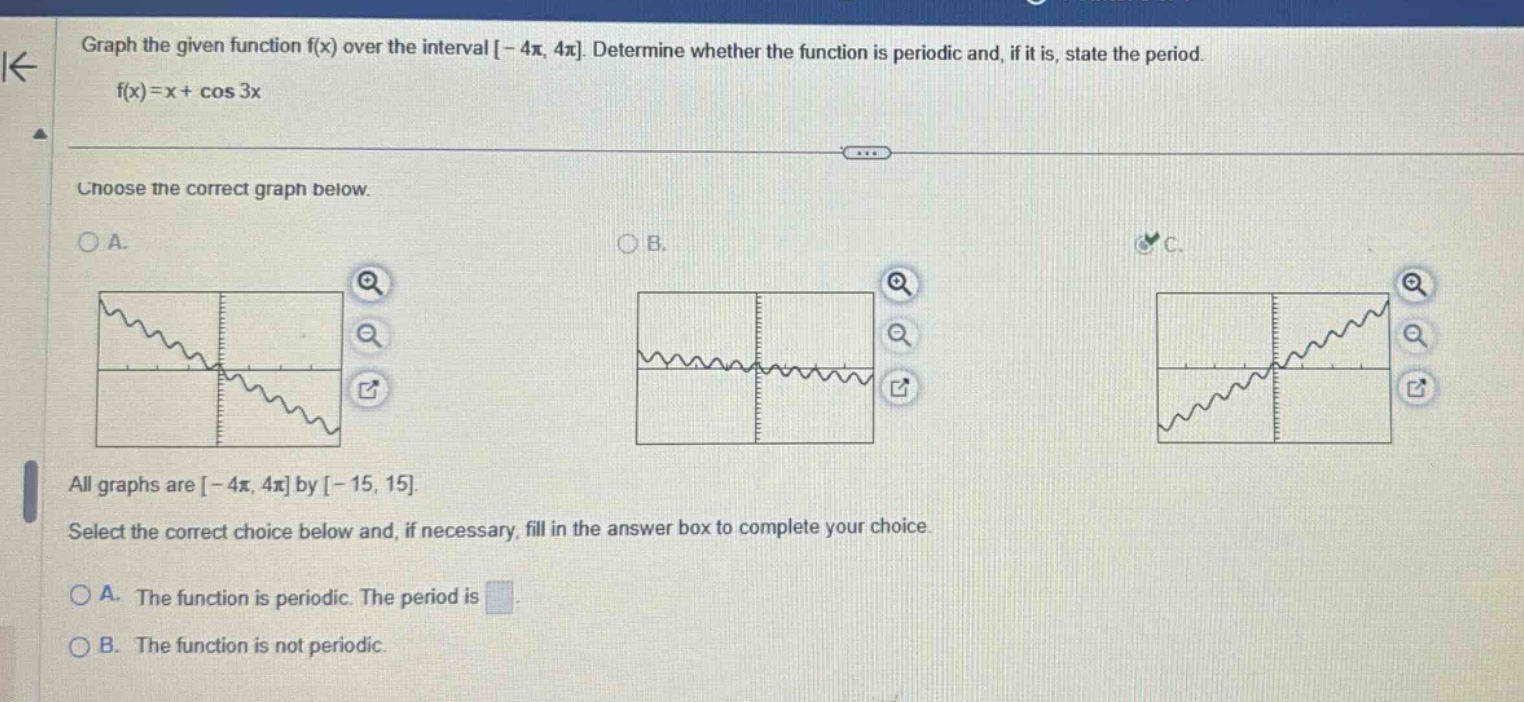
graph the given function f(x) over the interval -4π, 4π. determine whether the function is periodic and, if it is, state the period. f(x)=x + cos 3x choose the correct graph below. a. b. c. all graphs are -4π, 4π by -15, 15. select the correct choice below and, if necessary, fill in the answer box to complete your choice. a. the function is periodic. the period is. b. the function is not periodic.
Answer
Explanation:
Step1: Recall periodic - function definition
A function (y = f(x)) is periodic if there exists a positive number (T) such that (f(x + T)=f(x)) for all (x) in the domain of (f). Consider the two components of (f(x)=x+\cos(3x)). The function (y = \cos(3x)) is periodic. The period of (y=\cos(ax)) is (T_1=\frac{2\pi}{|a|}), so for (y = \cos(3x)), the period (T_1=\frac{2\pi}{3}). The function (y=x) is a linear function and is non - periodic.
Step2: Analyze the sum of the two functions
Let's assume that (f(x)=x+\cos(3x)) is periodic with period (T). Then (f(x + T)=(x + T)+\cos(3(x + T))=x+\cos(3x)) for all (x). Expanding, we get (x+T+\cos(3x + 3T)=x+\cos(3x)) for all (x). This implies (T+\cos(3x + 3T)=\cos(3x)) for all (x). Since (T) is a constant and the left - hand side has a non - constant term (T) and a periodic term (\cos(3x + 3T)), and the right - hand side is just a periodic term (\cos(3x)), there is no positive real number (T) that can satisfy this equation for all (x).
Answer:
B. The function is not periodic.