1. here is a graph of f given by f(θ) = tan(θ). a. are π/2 and 3π/2 in the domain of f? explain how you…
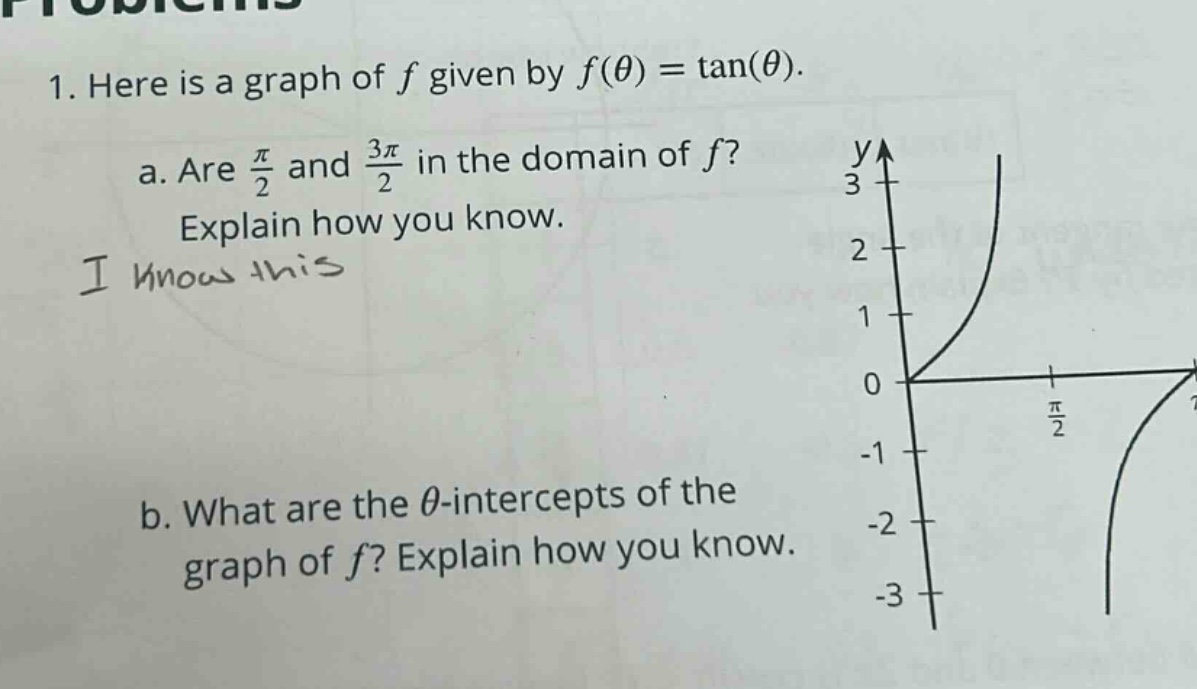
1. here is a graph of f given by f(θ) = tan(θ). a. are π/2 and 3π/2 in the domain of f? explain how you know. i know this b. what are the θ - intercepts of the graph of f? explain how you know.
Answer
Explanation:
Step1: Recall tangent - function domain
The tangent function is defined as $f(\theta)=\tan(\theta)=\frac{\sin(\theta)}{\cos(\theta)}$. The function is undefined when $\cos(\theta) = 0$. Since $\cos(\frac{\pi}{2})=0$ and $\cos(\frac{3\pi}{2}) = 0$, $\frac{\pi}{2}$ and $\frac{3\pi}{2}$ are not in the domain of $y = \tan(\theta)$.
Step2: Recall tangent - function zero - points
The $\theta$-intercepts of the graph of $y = f(\theta)$ occur when $f(\theta)=0$. Since $\tan(\theta)=\frac{\sin(\theta)}{\cos(\theta)}$, $\tan(\theta) = 0$ when $\sin(\theta)=0$ and $\cos(\theta)\neq0$. The values of $\theta$ for which $\sin(\theta)=0$ are $\theta = k\pi$, where $k\in\mathbb{Z}$. And for these values, $\cos(k\pi)=\pm1\neq0$ when $k\in\mathbb{Z}$. So the $\theta$-intercepts of the graph of $y = \tan(\theta)$ are $\theta=k\pi$, $k\in\mathbb{Z}$.
Answer:
a. No, because $\tan(\theta)=\frac{\sin(\theta)}{\cos(\theta)}$ and $\cos(\frac{\pi}{2}) = 0$, $\cos(\frac{3\pi}{2})=0$. b. The $\theta$-intercepts are $\theta = k\pi$, $k\in\mathbb{Z}$, because $\tan(\theta)=0$ when $\sin(\theta)=0$ and $\cos(\theta)\neq0$.