the graph of f is given below. use the graph to determine the following characteristics of f. if a solution…
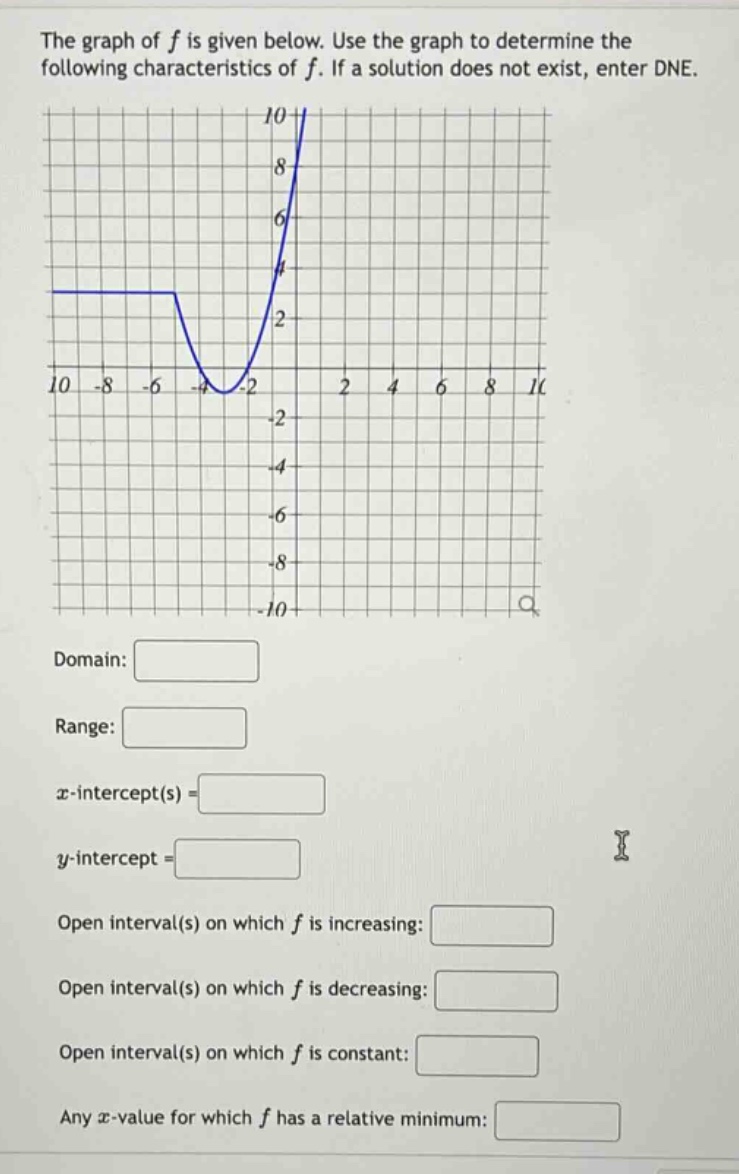
the graph of f is given below. use the graph to determine the following characteristics of f. if a solution does not exist, enter dne. domain: range: x - intercept(s) = y - intercept = open interval(s) on which f is increasing: open interval(s) on which f is decreasing: open interval(s) on which f is constant: any x - value for which f has a relative minimum:
Answer
Explanation:
Step1: Determine domain
The graph exists for all real - x values. So the domain is all real numbers, $(-\infty,\infty)$.
Step2: Determine range
The lowest y - value is $y = - 1$ and it goes up to $\infty$. So the range is $[-1,\infty)$.
Step3: Find x - intercepts
The graph crosses the x - axis at $x=-4$. So the x - intercept is $x = - 4$.
Step4: Find y - intercept
The graph crosses the y - axis at $y = 4$. So the y - intercept is $y = 4$.
Step5: Find increasing intervals
The graph is rising for $x>-4$. So the increasing interval is $(-4,\infty)$.
Step6: Find decreasing intervals
The graph is falling for $x < - 4$. So the decreasing interval is $(-\infty,-4)$.
Step7: Find constant intervals
The graph is not flat anywhere, so the constant interval is DNE.
Step8: Find x - value for relative minimum
The relative minimum occurs at the lowest point of the graph, which is at $x=-4$.
Answer:
Domain: $(-\infty,\infty)$ Range: $[-1,\infty)$ $x$-intercept(s): $x = - 4$ $y$-intercept: $y = 4$ Open interval(s) on which $f$ is increasing: $(-4,\infty)$ Open interval(s) on which $f$ is decreasing: $(-\infty,-4)$ Open interval(s) on which $f$ is constant: DNE Any $x$-value for which $f$ has a relative minimum: $x=-4$