here is a graph of $f(x)=e^{x}$ and a graph of $g$, which is a transformation of $f$. write an equation for…
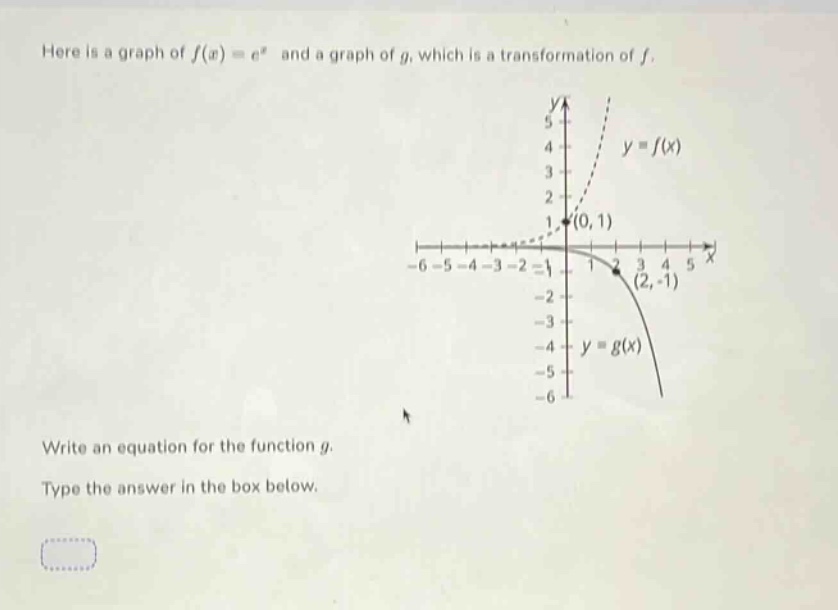
here is a graph of $f(x)=e^{x}$ and a graph of $g$, which is a transformation of $f$. write an equation for the function $g$. type the answer in the box below.
Answer
Explanation:
Step1: Recall general transformation form
The general form of a transformation of the function $y = f(x)$ is $y=a\cdot f(b(x - h))+k$.
Step2: Analyze vertical - reflection
The graph of $y = f(x)=e^{x}$ is reflected vertically about the $x$ - axis. A vertical reflection is given by multiplying the function by $- 1$, so $a=-1$.
Step3: Check for horizontal and vertical shifts
There is no horizontal shift ($h = 0$) and no vertical shift ($k = 0$) and no horizontal stretch or compression ($b = 1$). Since $f(x)=e^{x}$, the transformed function $g(x)=-e^{x}$.
Answer:
$g(x)=-e^{x}$