graph this inequality:\n$y \\leq \\frac{1}{3}x - 1$\nplot points on the boundary line. select the line to…
graph this inequality:\n$y \\leq \\frac{1}{3}x - 1$\nplot points on the boundary line. select the line to switch between solid and dotted. select a region to shade it.
Answer
Explanation:
Step1: Identify the boundary line type
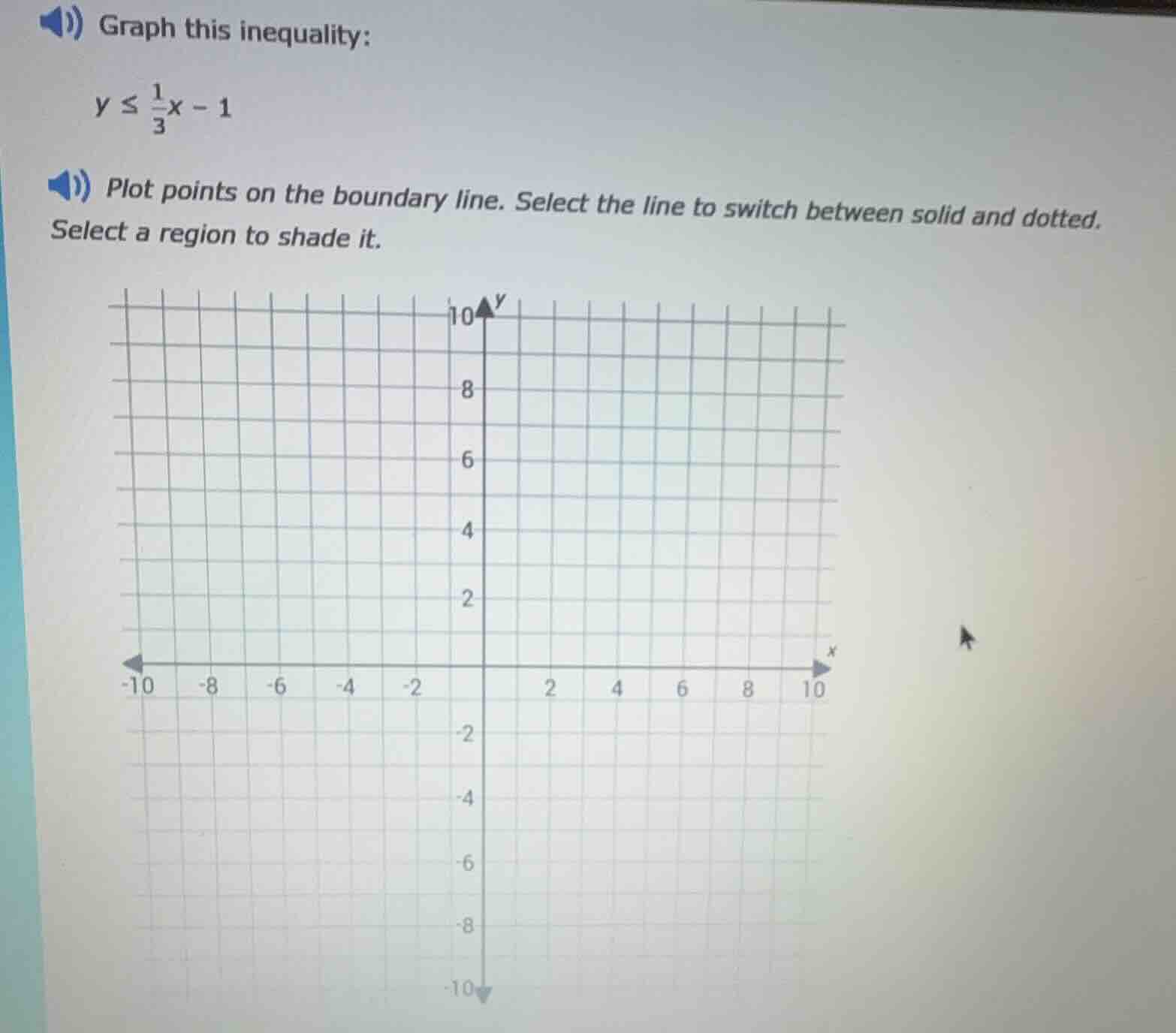
The inequality is ( y \leq \frac{1}{3}x - 1 ). Since the inequality is "less than or equal to", the boundary line ( y=\frac{1}{3}x - 1 ) should be solid (because the inequality includes equality, so points on the line are part of the solution set).
Step2: Find two points on the boundary line
- When ( x = 0 ): Substitute ( x = 0 ) into ( y=\frac{1}{3}x - 1 ), we get ( y=\frac{1}{3}(0)-1=-1 ). So one point is ( (0, - 1) ).
- When ( x = 3 ): Substitute ( x = 3 ) into ( y=\frac{1}{3}x - 1 ), we get ( y=\frac{1}{3}(3)-1 = 1 - 1=0 ). So another point is ( (3,0) ).
Step3: Determine the region to shade
To determine which side of the line to shade, we can test a point not on the line. Let's use the origin ( (0,0) ). Substitute ( x = 0 ) and ( y = 0 ) into the inequality ( y\leq\frac{1}{3}x - 1 ): ( 0\leq\frac{1}{3}(0)-1 ) ( 0\leq - 1 ), which is false. So we shade the region that does not include the origin.
Answer:
- Draw a solid line through the points ((0, - 1)) and ((3,0)) (you can find more points by plugging in other (x)-values into (y=\frac{1}{3}x - 1), e.g., when (x = 6), (y=\frac{1}{3}(6)-1=2 - 1 = 1), so ((6,1)) is also on the line).
- Shade the region below the solid line (since the test point ((0,0)) was not in the solution set, and the inequality is (y\leq\frac{1}{3}x - 1), we shade where (y) - values are less than or equal to the line's (y) - values).