the graph of y = ln x and the corresponding points that lie on the graph of f(x)=2 + ln x. points that lie…
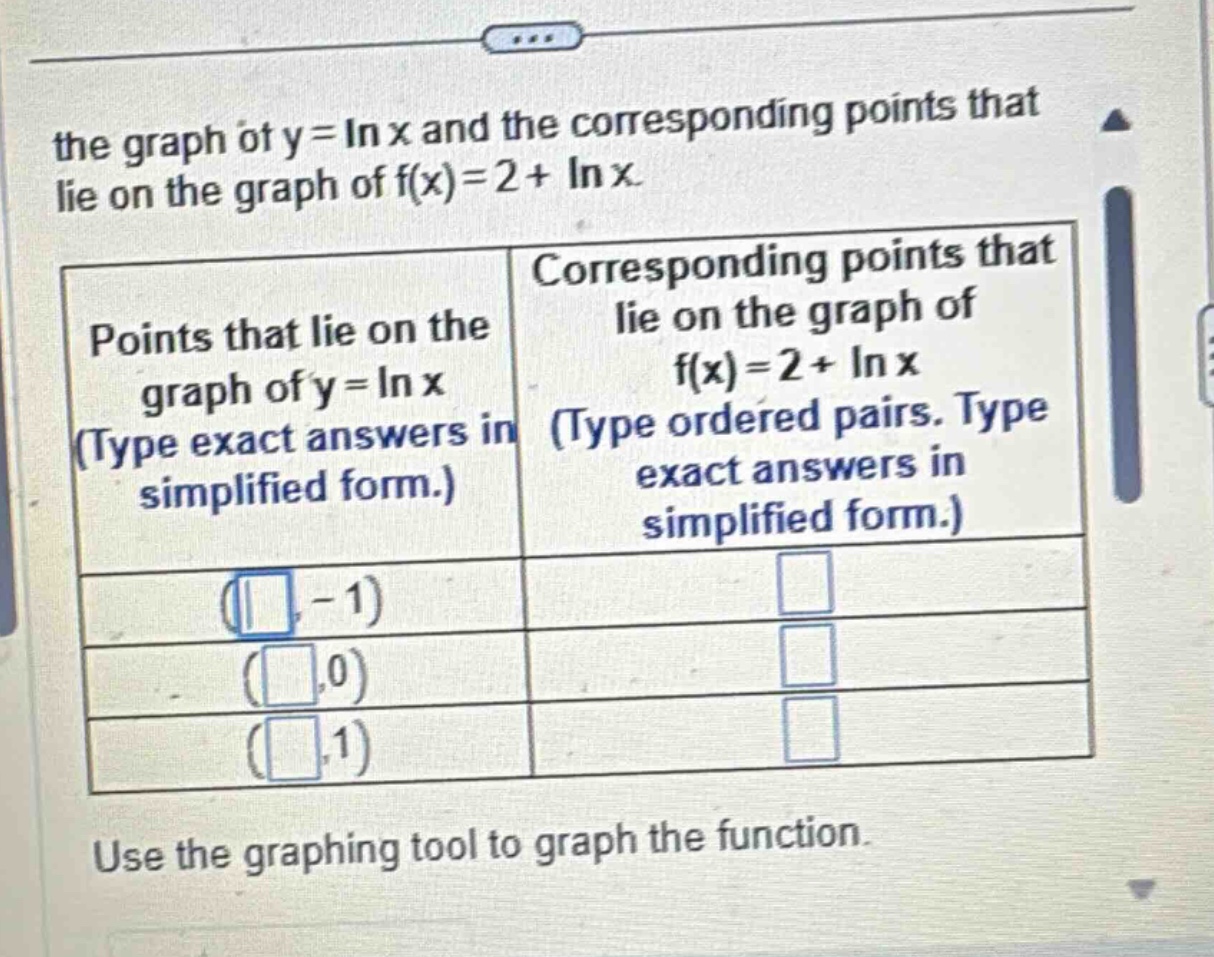
the graph of y = ln x and the corresponding points that lie on the graph of f(x)=2 + ln x. points that lie on the graph of y = ln x (type exact answers in simplified form.) (-1) (0) (1) corresponding points that lie on the graph of f(x)=2 + ln x (type ordered pairs. type exact answers in simplified form.) use the graphing tool to graph the function.
Answer
Explanation:
Step1: Find x - value for y = - 1 in y = ln x
Set ln x=-1. By the definition of the natural - logarithm, if ln x = a, then x = e^a. So x = e^(-1)=\frac{1}{e}.
Step2: Find the corresponding point on f(x)=2 + ln x
Substitute x=\frac{1}{e} into f(x). f(\frac{1}{e})=2+\ln(\frac{1}{e})=2 - 1 = 1. The point is (\frac{1}{e},1).
Step3: Find x - value for y = 0 in y = ln x
Set ln x = 0. Since ln x = 0 when x = e^0=1.
Step4: Find the corresponding point on f(x)=2 + ln x
Substitute x = 1 into f(x). f(1)=2+\ln(1)=2+0 = 2. The point is (1,2).
Step5: Find x - value for y = 1 in y = ln x
Set ln x = 1. Then x = e^1=e.
Step6: Find the corresponding point on f(x)=2 + ln x
Substitute x = e into f(x). f(e)=2+\ln(e)=2 + 1=3. The point is (e,3).
Answer:
| Points that lie on the graph of y = ln x | Corresponding points that lie on the graph of f(x)=2 + ln x |
|---|---|
| (\frac{1}{e},-1) | (\frac{1}{e},1) |
| (1,0) | (1,2) |
| (e,1) | (e,3) |