9. the graph of the logarithmic function (f(x)) is shown. graph the function (k(x)=f(x + 6)+4) on the same…
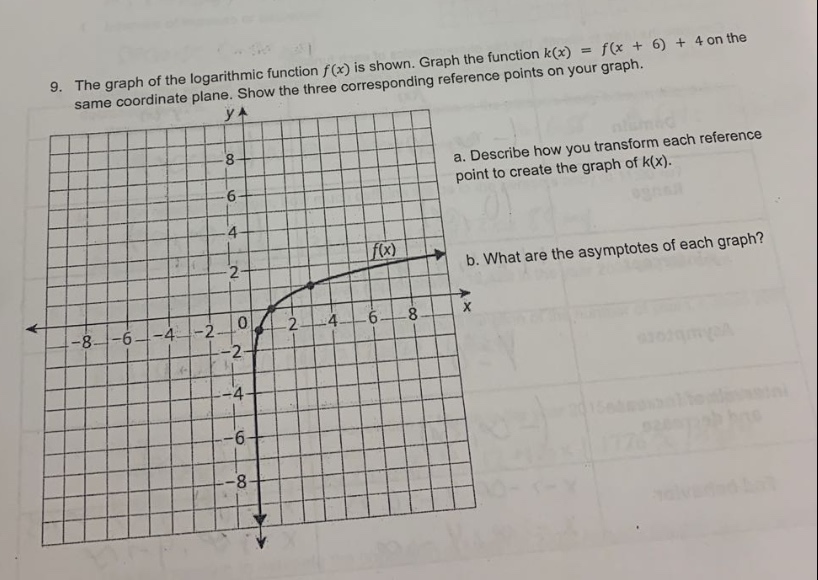
9. the graph of the logarithmic function (f(x)) is shown. graph the function (k(x)=f(x + 6)+4) on the same coordinate plane. show the three corresponding reference points on your graph.\na. describe how you transform each reference point to create the graph of (k(x)).\nb. what are the asymptotes of each graph?
Answer
Explanation:
Step1: Recall function - transformation rules
For a function (y = f(x)), (y=f(x + h)+k) is a horizontal shift by (h) units (left if (h>0), right if (h < 0)) and a vertical shift by (k) units (up if (k>0), down if (k < 0)). Here (h = 6) and (k = 4), so the graph of (y = f(x)) is shifted 6 units to the left and 4 units up to get (k(x)=f(x + 6)+4).
Step2: Analyze reference - point transformation
Let a reference point on (y = f(x)) be ((x_0,y_0)). The corresponding point on (k(x)) will be ((x_0-6,y_0 + 4)). For example, if a point on (f(x)) is ((1,0)) (assuming from the general shape of a logarithmic - type graph), the corresponding point on (k(x)) is ((1 - 6,0 + 4)=(-5,4)).
Step3: Determine asymptotes
For a logarithmic function (y = f(x)=\log(x)) (assuming the basic form of the given (f(x))), the vertical asymptote is (x = 0). For the function (k(x)=f(x + 6)+4), the vertical asymptote is found by setting (x+6=0), so (x=-6). The horizontal asymptote of a basic logarithmic function (y = f(x)) does not exist (it is a non - rational function with a vertical asymptote). Since we are only shifting the function vertically and horizontally, the non - existence of the horizontal asymptote remains the same for (k(x)).
a.
To transform each reference point on (f(x)) to create the graph of (k(x)), we subtract 6 from the (x) - coordinate and add 4 to the (y) - coordinate of each reference point on (f(x)).
b.
The vertical asymptote of (f(x)) is (x = 0). The vertical asymptote of (k(x)) is (x=-6). Neither (f(x)) nor (k(x)) has a horizontal asymptote.