above is the graph of: none of these. f(x) = arctan x f(x) = arccos x f(x) = arcsin x f(x) = arcsec x
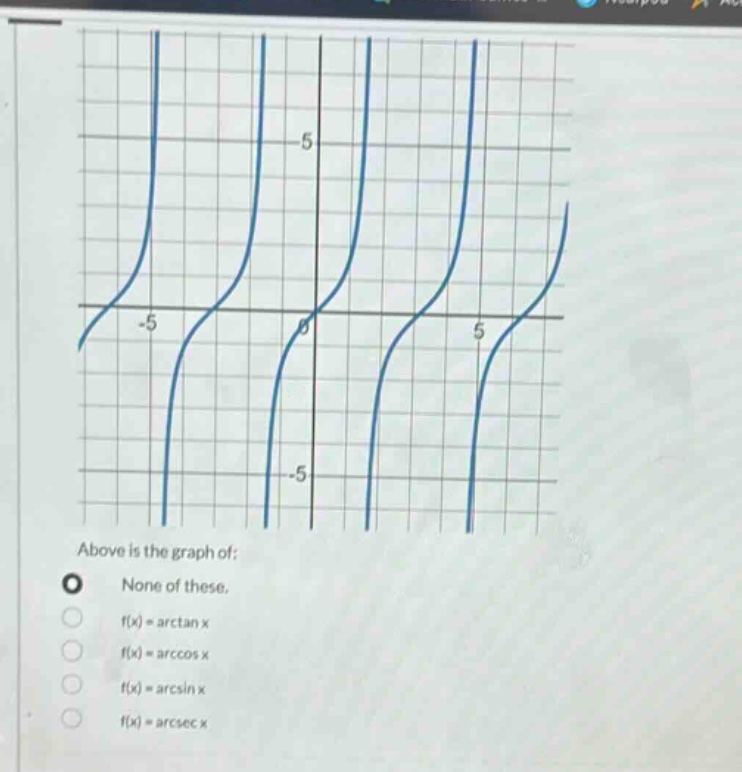
above is the graph of: none of these. f(x) = arctan x f(x) = arccos x f(x) = arcsin x f(x) = arcsec x
Answer
Explanation:
Step1: Recall domain and range of inverse - trig functions
The domain and range of (y = \arctan(x)) is ((-\infty,\infty)) and ((-\frac{\pi}{2},\frac{\pi}{2})) respectively, and its graph has horizontal asymptotes (y =-\frac{\pi}{2}) and (y=\frac{\pi}{2}). The domain of (y=\arccos(x)) is ([- 1,1]) and range is ([0,\pi]). The domain of (y = \arcsin(x)) is ([-1,1]) and range is ([-\frac{\pi}{2},\frac{\pi}{2}]). The domain of (y=\text{arcsec}(x)) is ((-\infty,-1]\cup[1,\infty)) and range is ([0,\frac{\pi}{2})\cup(\frac{\pi}{2},\pi]).
Step2: Analyze the given graph
The given graph has vertical asymptotes and is periodic - like in nature. None of the standard inverse - trigonometric functions (\arctan(x)), (\arccos(x)), (\arcsin(x)), (\text{arcsec}(x)) have such a graph.
Answer:
None of these