the graph of one complete period of a cosine curve is given. (a) find the amplitude, period, and horizontal…
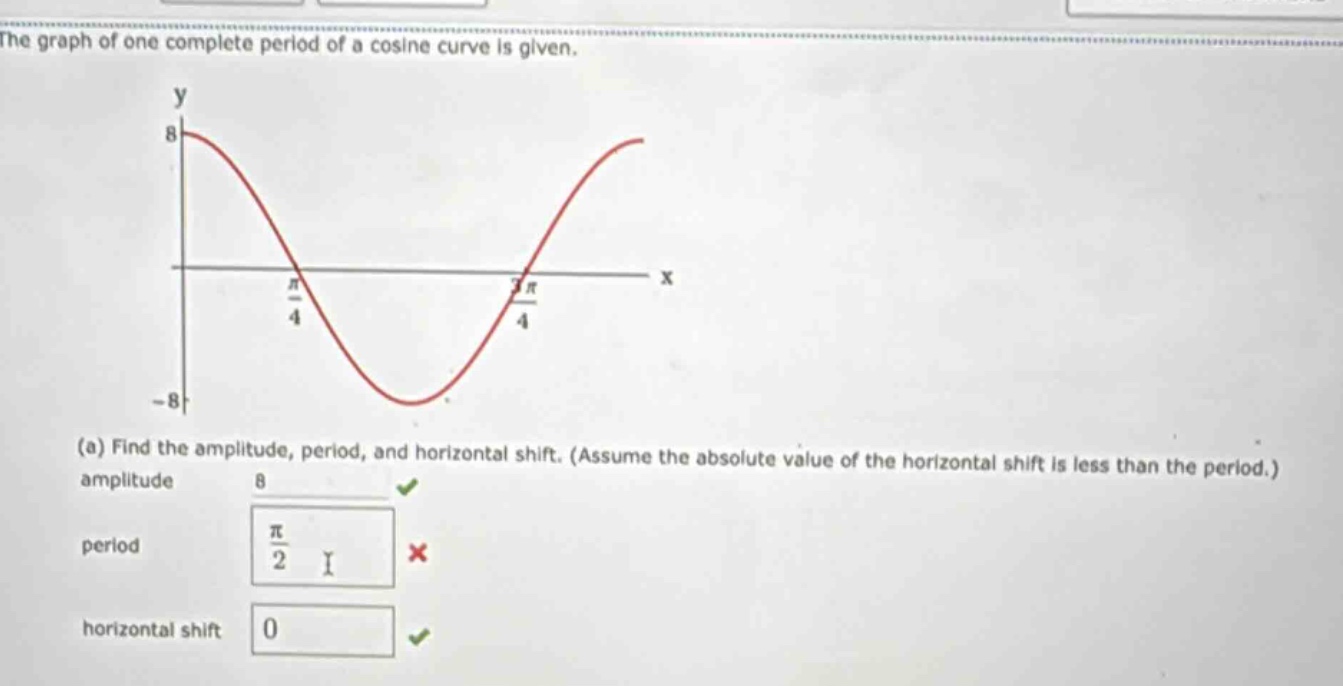
the graph of one complete period of a cosine curve is given. (a) find the amplitude, period, and horizontal shift. (assume the absolute value of the horizontal shift is less than the period.) amplitude 8 period π/2 i × horizontal shift 0 √
Answer
Explanation:
Step1: Recall amplitude formula
The amplitude $A$ of a cosine - curve $y = A\cos(Bx - C)+D$ is the absolute value of the coefficient of the cosine function. For a cosine - curve, the amplitude is the distance from the maximum (or minimum) value to the mid - line. Here, the maximum value is $y = 8$ and the minimum value is $y=-8$, and the mid - line is $y = 0$. So, $A=\vert8\vert = 8$.
Step2: Recall period formula
The period $T$ of a cosine function $y = A\cos(Bx - C)+D$ is given by $T=\frac{2\pi}{\vert B\vert}$. The distance between two consecutive maximum or minimum or x - intercepts that complete one - cycle is the period. The x - intercepts are at $x=\frac{\pi}{4}$ and $x = \frac{3\pi}{4}$, and the full period is from $x = \frac{\pi}{4}$ to $x=\frac{\pi}{4}+T$. Since the distance between two consecutive x - intercepts is half of the period, and the distance between $x=\frac{\pi}{4}$ and $x=\frac{3\pi}{4}$ is $\frac{3\pi}{4}-\frac{\pi}{4}=\frac{\pi}{2}$, the period $T=\pi$.
Step3: Recall horizontal - shift formula
The horizontal shift (phase shift) of the cosine function $y = A\cos(Bx - C)+D$ is given by $\frac{C}{B}$. If the cosine function $y = A\cos(Bx - C)+D$ has a maximum at $x = 0$ (or the graph is in its standard position with respect to the y - axis), the horizontal shift is 0. Here, the cosine curve is symmetric about the y - axis, so the horizontal shift $h = 0$.
Answer:
amplitude: 8 period: $\pi$ horizontal shift: 0