how is the graph of the parent function ( y = \frac{1}{x} ) transformed to create the graph of ( y =…
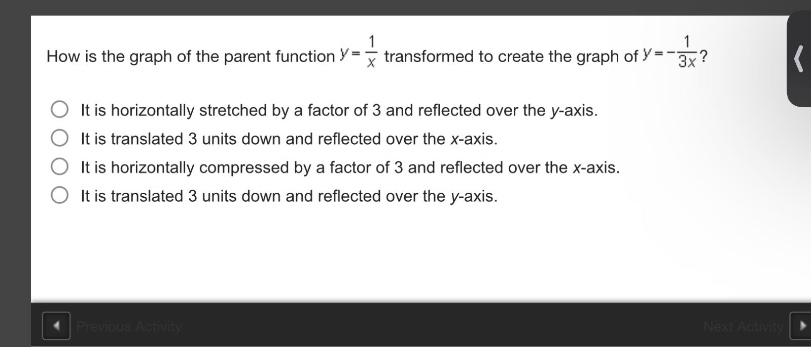
how is the graph of the parent function ( y = \frac{1}{x} ) transformed to create the graph of ( y = -\frac{1}{3x} )?\nit is horizontally stretched by a factor of 3 and reflected over the ( y )-axis.\nit is translated 3 units down and reflected over the ( x )-axis.\nit is horizontally compressed by a factor of 3 and reflected over the ( x )-axis.\nit is translated 3 units down and reflected over the ( y )-axis.
Answer
Explanation:
Step1: Recall the transformation rules for functions
For a function (y = \frac{a}{bx + c}+d), the coefficient (b) affects the horizontal stretch/compression ((\vert b\vert> 1) is horizontal compression, (0<\vert b\vert < 1) is horizontal stretch) and the sign of (a) affects the reflection. The general form of transformation for (y=\frac{1}{x}) to (y = \frac{a}{bx}) is considered. For the parent function (y=\frac{1}{x}) and the transformed function (y =-\frac{1}{3x}), when comparing (y=\frac{1}{x}) and (y=\frac{1}{3x}), since (b = 3>1), the graph of (y=\frac{1}{x}) is horizontally compressed by a factor of (3) (using the rule (y = f(bx)) where (b>1) compresses (y = f(x)) horizontally by a factor of (\frac{1}{b})).
Step2: Analyze the reflection
When comparing (y=\frac{1}{3x}) and (y=-\frac{1}{3x}), using the rule (y=-f(x)) (reflection of (y = f(x)) over the (x) - axis). The negative sign in front of (\frac{1}{3x}) reflects the graph of (y=\frac{1}{3x}) over the (x) - axis.
Answer:
It is horizontally compressed by a factor of 3 and reflected over the x - axis.