how is the graph of the parent function $y = \\frac{1}{x}$ transformed to create the graph of…
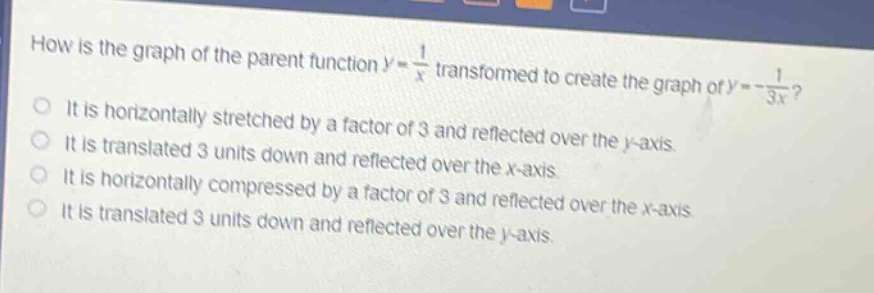
how is the graph of the parent function $y = \\frac{1}{x}$ transformed to create the graph of $y=-\\frac{1}{3x}$?\nit is horizontally stretched by a factor of 3 and reflected over the y - axis.\nit is translated 3 units down and reflected over the x - axis.\nit is horizontally compressed by a factor of 3 and reflected over the x - axis.\nit is translated 3 units down and reflected over the y - axis.
Answer
Explanation:
Step1: Analizar la transformación de la función
La función padre es (y = \frac{1}{x}). La función transformada es (y=-\frac{1}{3x}). Para una función (y = \frac{a}{bx + c}+d), el factor de compresión/estiramiento horizontal es dado por (\frac{1}{|b|}) y la reflexión se ve en el signo de (a).
Step2: Calcular el factor de compresión/estiramiento horizontal
Para (y =-\frac{1}{3x}), (b = 3). El factor de compresión horizontal es (\frac{1}{|3|}=\frac{1}{3}), lo que significa que la gráfica de la función padre (y=\frac{1}{x}) se comprime horizontalmente por un factor de 3.
Step3: Analizar la reflexión
Como (a=- 1), la gráfica se refleja sobre el eje (x) (ya que la reflexión sobre el eje (x) se realiza al multiplicar por (-1) la función (y = f(x)) para obtener (y=-f(x)))
Answer:
It is horizontally compressed by a factor of 3 and reflected over the (x) - axis.