how is the graph of the parent function, ( y = sqrt{x} ) transformed to produce the graph of ( y = sqrt{-2x}…
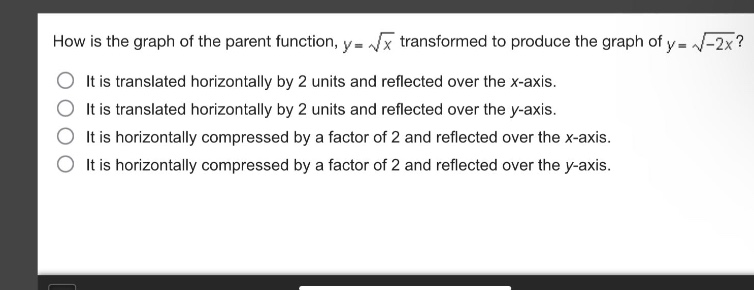
how is the graph of the parent function, ( y = sqrt{x} ) transformed to produce the graph of ( y = sqrt{-2x} )?\nit is translated horizontally by 2 units and reflected over the x - axis.\nit is translated horizontally by 2 units and reflected over the y - axis.\nit is horizontally compressed by a factor of 2 and reflected over the x - axis.\nit is horizontally compressed by a factor of 2 and reflected over the y - axis.
Answer
Explanation:
Step1: Recall the transformation rules
For a function (y = f(x)), a horizontal compression by a factor of (a) gives (y = f(ax)), and a reflection over the (y -)axis gives (y=f(-x)). Let the parent function be (y = \sqrt{x}). For the function (y=\sqrt{-2x}), we can rewrite it as (y=\sqrt{-2x}=\sqrt{2(-x)}).
Step2: Analyze the transformation
First, consider the transformation from (y = \sqrt{x}) to (y=\sqrt{2x}). According to the rule (y = f(ax)) ((a> 1)), when (a = 2), the graph of (y=\sqrt{x}) is horizontally compressed by a factor of (2) (since for a function (y = f(x)) and (y=f(ax)), if (a>1), the graph of (y = f(x)) is compressed horizontally by a factor of (\frac{1}{a})). Then, consider the transformation from (y=\sqrt{2x}) to (y=\sqrt{-2x}). According to the rule (y = f(-x)), the graph is reflected over the (y -)axis.
Answer:
It is horizontally compressed by a factor of 2 and reflected over the (y -)axis.