graph the rational function.\n f(x)=\frac{-2x^{2}-16x}{x^{2}+8x + 12} \nstart by drawing the vertical and…
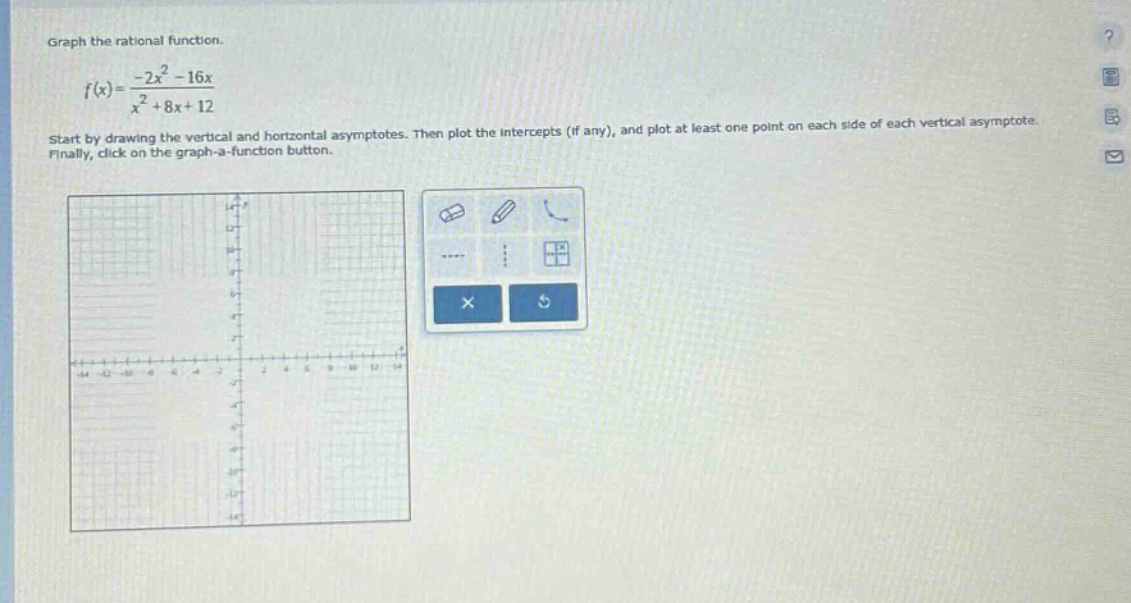
graph the rational function.\n f(x)=\frac{-2x^{2}-16x}{x^{2}+8x + 12} \nstart by drawing the vertical and horizontal asymptotes. then plot the intercepts (if any), and plot at least one point on each side of each vertical asymptote. finally, click on the graph - a - function button.
Answer
Explanation:
Step1: Factor the function
First, factor the numerator and denominator. The numerator (-2x^{2}-16x=-2x(x + 8)). The denominator (x^{2}+8x + 12=(x + 2)(x+6)). So (f(x)=\frac{-2x(x + 8)}{(x + 2)(x + 6)}).
Step2: Find vertical asymptotes
Set the denominator equal to zero ((x + 2)(x + 6)=0). Solving (x+2 = 0) gives (x=-2) and solving (x + 6=0) gives (x=-6). So the vertical asymptotes are (x=-2) and (x=-6).
Step3: Find horizontal asymptote
Since the degree of the numerator and denominator are the same (both degree 2), the horizontal - asymptote is (y=\frac{-2}{1}=-2) (the ratio of the leading coefficients).
Step4: Find x - intercepts
Set the numerator equal to zero (-2x(x + 8)=0). Solving (-2x=0) gives (x = 0) and solving (x+8=0) gives (x=-8). So the x - intercepts are (x = 0) and (x=-8).
Step5: Find y - intercept
Set (x = 0) in the function (f(0)=\frac{-2\times0^{2}-16\times0}{0^{2}+8\times0 + 12}=0). So the y - intercept is (y = 0).
Step6: Plot points
For (x=-7) (left of (x=-6)), (f(-7)=\frac{-2\times(-7)\times(-7 + 8)}{(-7 + 2)\times(-7+6)}=\frac{14}{5}=2.8). For (x=-5) (between (x=-6) and (x=-2)), (f(-5)=\frac{-2\times(-5)\times(-5 + 8)}{(-5 + 2)\times(-5+6)}=\frac{30}{-3}=-10). For (x=-1) (right of (x=-2)), (f(-1)=\frac{-2\times(-1)\times(-1 + 8)}{(-1 + 2)\times(-1+6)}=\frac{14}{5}=2.8).
To graph: Draw the vertical asymptotes (x=-2) and (x=-6) as dashed lines, draw the horizontal asymptote (y=-2) as a dashed line. Plot the x - intercepts ((0,0)) and ((-8,0)), the y - intercept ((0,0)), and the points ((-7,2.8)), ((-5,-10)), ((-1,2.8)) and then sketch the graph of the rational function approaching the asymptotes.
Answer:
Graph the function with vertical asymptotes (x=-2) and (x=-6), horizontal asymptote (y=-2), x - intercepts at (x = 0) and (x=-8), y - intercept at (y = 0) and additional points ((-7,2.8)), ((-5,-10)), ((-1,2.8))