the graph represents the function f(x) = 10(2)^x. how would the graph change if the b - value in the…
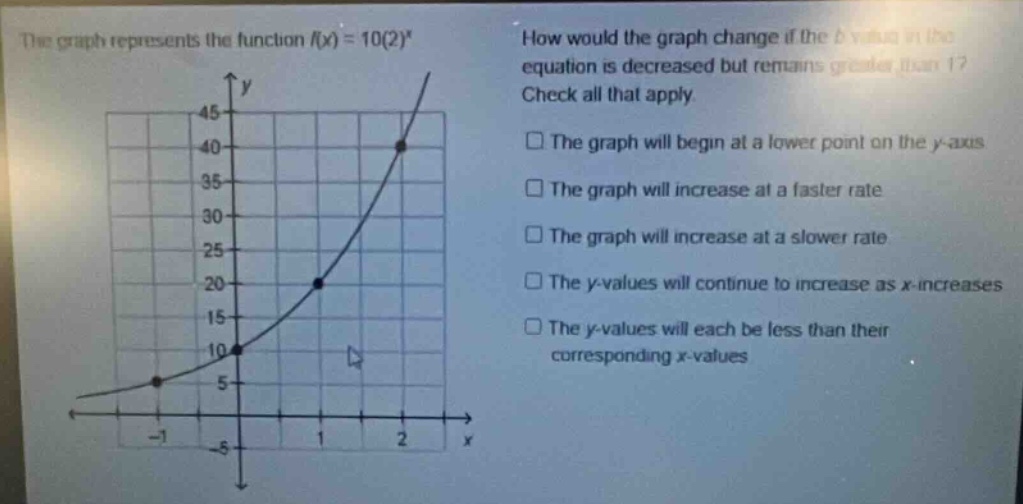
the graph represents the function f(x) = 10(2)^x. how would the graph change if the b - value in the equation is decreased but remains greater than 1? check all that apply. the graph will begin at a lower point on the y - axis. the graph will increase at a faster rate. the graph will increase at a slower rate. the y - values will continue to increase as x - increases. the y - values will each be less than their corresponding x - values.
Answer
Explanation:
Step1: Recall exponential - function form
The general form of an exponential function is (y = a(b)^x), where (a) is the initial - value ((y) - intercept when (x = 0)) and (b) is the base. In the function (y = 10(2)^x), (a = 10) and (b = 2). The (y) - intercept is at the point ((0,10)) and does not depend on the value of (b) (as long as (x = 0)). So, changing (b) (while (b>1)) will not change the starting point on the (y) - axis.
Step2: Analyze the effect of (b) on the growth rate
The growth rate of an exponential function (y=a(b)^x) is determined by the base (b). When (b>1), the function is an exponential growth function. A larger value of (b) means a faster - growing function, and a smaller value of (b) (but still (b > 1)) means a slower - growing function. So, if (b) is decreased (but (b>1)), the graph will increase at a slower rate.
Step3: Consider the behavior as (x) increases
For an exponential function (y=a(b)^x) with (a>0) and (b > 1), as (x) increases, (y) will always increase. Decreasing (b) (while (b>1)) does not change the fact that (y) increases as (x) increases.
Step4: Analyze the relationship between (x) and (y) values
There is no general rule that the (y) - values will be less than their corresponding (x) - values for an exponential function (y=a(b)^x) with (a>0) and (b > 1). For example, when (x = 2) in (y = 10(2)^x), (y=40) which is much larger than (x = 2).
Answer:
The graph will increase at a slower rate; The (y) - values will continue to increase as (x) increases.