the graph represents a function with the form f(x) = asin(bx + c). which values of a, b, and c are possible…
the graph represents a function with the form f(x) = asin(bx + c). which values of a, b, and c are possible? a = 6, b = 1, c = π/3 a = 6, b = 3, c = π a = 3, b = 1, c = π/3 a = 3, b = 6, c = π
Answer
Explanation:
Step1: Determine the amplitude
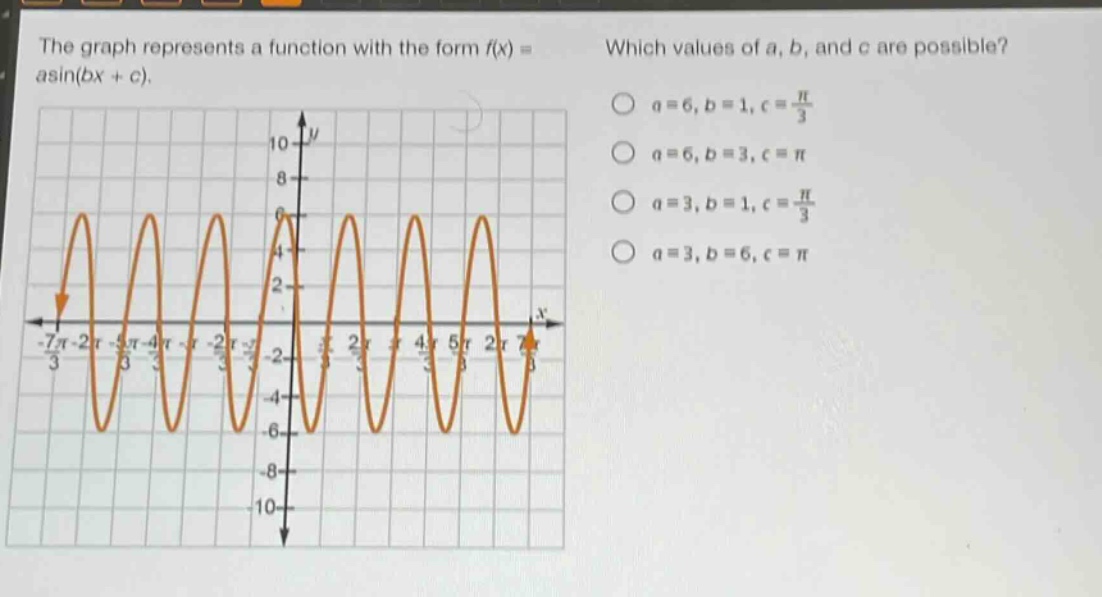
The amplitude of the sine - function (y = a\sin(bx + c)) is (|a|). The distance from the maximum value to the mid - line of the graph is the amplitude. The maximum value of the given graph is (6) and the minimum value is (- 6), so the mid - line is (y = 0) and the amplitude (|a|=6), so (a=\pm6).
Step2: Determine the period
The period (T) of the sine - function (y = a\sin(bx + c)) is given by (T=\frac{2\pi}{|b|}). From the graph, we can see that the period (T=\frac{2\pi}{3}). Then (\frac{2\pi}{|b|}=\frac{2\pi}{3}), so (|b| = 3), (b=\pm3).
Step3: Check the phase - shift
We can also check the phase - shift. But from the amplitude and period analysis, we can already eliminate some options. The option that satisfies (a = 6) and (b = 3) is (a = 6,b = 3,c=\pi).
Answer:
(a = 6,b = 3,c=\pi)