which graph represents the function $f(x)=\\frac{2}{x - 1}+4$?
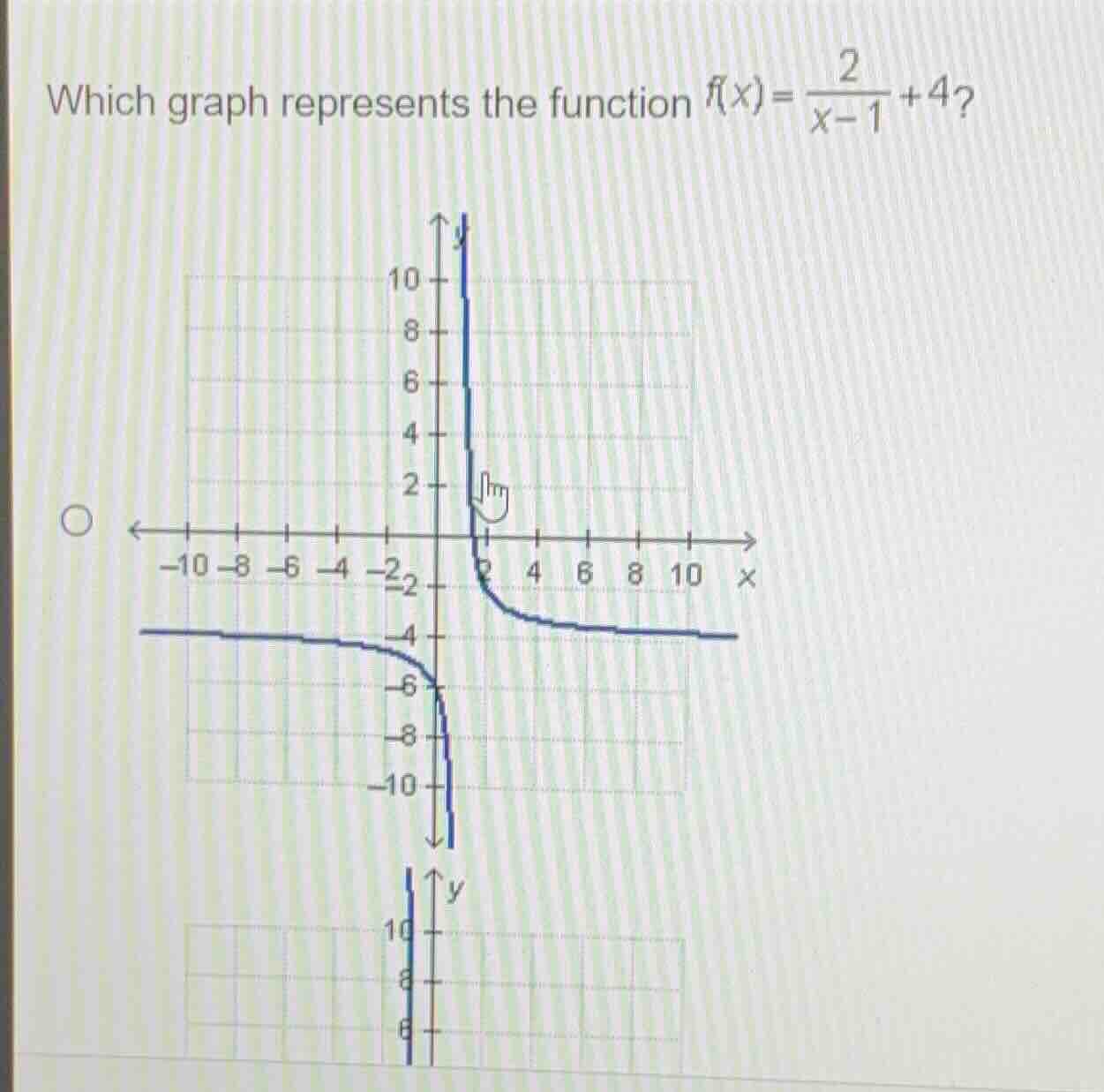
which graph represents the function $f(x)=\\frac{2}{x - 1}+4$?
Answer
Explanation:
Step1: Identify Vertical Asymptote
For the function ( f(x)=\frac{2}{x - 1}+4 ), the vertical asymptote occurs where the denominator is zero, i.e., ( x - 1 = 0\Rightarrow x = 1 ). So the graph should have a vertical asymptote at ( x = 1 ).
Step2: Identify Horizontal Asymptote
For rational functions of the form ( \frac{a}{x - h}+k ), the horizontal asymptote is ( y = k ). Here, ( k = 4 ), so the horizontal asymptote is ( y = 4 ).
Step3: Analyze Behavior Around Asymptotes
- For ( x>1 ) (right of ( x = 1 )), as ( x\rightarrow1^+ ), ( \frac{2}{x - 1}\rightarrow+\infty ), so ( f(x)\rightarrow+\infty ); as ( x\rightarrow+\infty ), ( \frac{2}{x - 1}\rightarrow0 ), so ( f(x)\rightarrow4 ).
- For ( x<1 ) (left of ( x = 1 )), as ( x\rightarrow1^- ), ( \frac{2}{x - 1}\rightarrow-\infty ), so ( f(x)\rightarrow-\infty ); as ( x\rightarrow-\infty ), ( \frac{2}{x - 1}\rightarrow0 ), so ( f(x)\rightarrow4 ).
We check the given graph (the first one shown) has vertical asymptote at ( x = 1 ), horizontal asymptote at ( y = 4 ), and the behavior matches the function's properties (right side approaches ( +\infty ) near ( x = 1 ) and approaches ( 4 ) as ( x\rightarrow\pm\infty ), left side approaches ( -\infty ) near ( x = 1 ) and approaches ( 4 ) as ( x\rightarrow-\infty )).
Answer:
The graph (the one with vertical asymptote ( x = 1 ) and horizontal asymptote ( y = 4 ), showing the correct behavior around ( x = 1 ) and ( y = 4 )) represents the function ( f(x)=\frac{2}{x - 1}+4 ). (Assuming the first graph in the provided image has these properties, so the answer is the graph with vertical asymptote ( x = 1 ) and horizontal asymptote ( y = 4 ) as analyzed.)