the graph of ( g(x) ) is the result of translating the graph of ( f(x)=left(\frac{1}{2}\right)^{x} ) three…
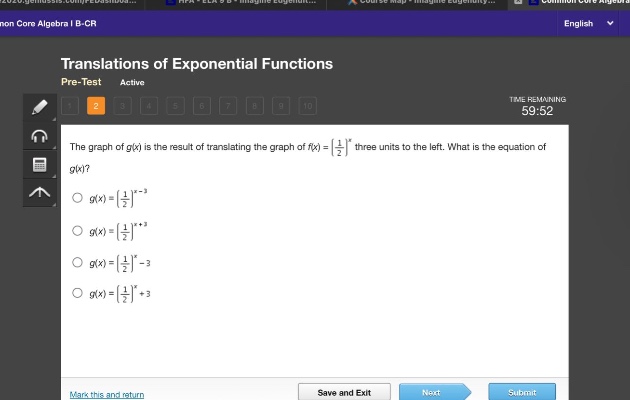
the graph of ( g(x) ) is the result of translating the graph of ( f(x)=left(\frac{1}{2}\right)^{x} ) three units to the left. what is the equation of ( g(x) )?\n( g(x)=left(\frac{1}{2}\right)^{x - 3} )\n( g(x)=left(\frac{1}{2}\right)^{x+3} )\n( g(x)=left(\frac{1}{2}\right)^{x}-3 )\n( g(x)=left(\frac{1}{2}\right)^{x}+3 )
Answer
Explanation:
Step1: Recall the horizontal translation rule
For a function (y = f(x)), translating it (h) units to the left gives (y=f(x + h)).
Step2: Apply the rule to the given function
Here, (f(x)=\left(\frac{1}{2}\right)^x) and (h = 3) (translation to the left). So (g(x)=\left(\frac{1}{2}\right)^{x+3}).
Answer:
(g(x)=\left(\frac{1}{2}\right)^{x + 3}), so the second option (g(x)=\left(\frac{1}{2}\right)^{x+3}) is correct.