the graph to the right is a function of the form y = a sin (bx - c)+d, b > 0. the five quarter - points of…
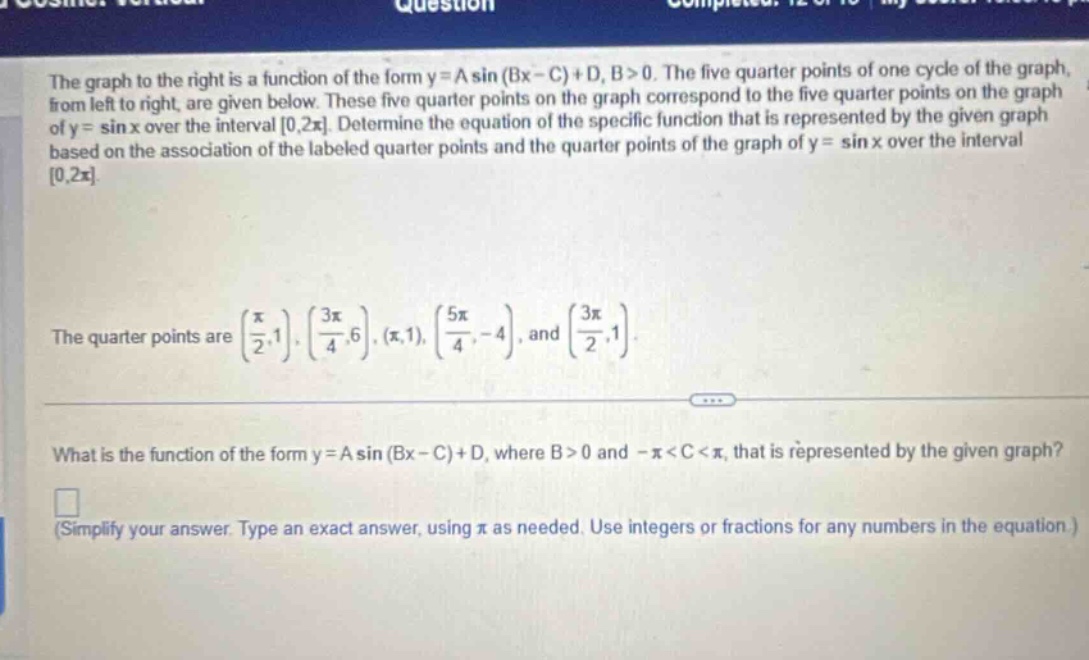
the graph to the right is a function of the form y = a sin (bx - c)+d, b > 0. the five quarter - points of one cycle of the graph, from left to right, are given below. these five quarter - points on the graph correspond to the five quarter - points on the graph of y = sin x over the interval 0,2π. determine the equation of the specific function that is represented by the given graph based on the association of the labeled quarter - points and the quarter - points of the graph of y = sin x over the interval 0,2π. the quarter points are (π/2,1), (3π/4,6), (π,1), (5π/4, - 4), and (3π/2,1). what is the function of the form y = a sin (bx - c)+d, where b > 0 and - π < c < π, that is represented by the given graph? (simplify your answer. type an exact answer, using π as needed. use integers or fractions for any numbers in the equation.)
Answer
Explanation:
Step1: Find the amplitude A
The amplitude is half the vertical distance between the maximum and minimum values. The maximum value is 6 and the minimum is - 4. So, $A=\frac{6 - (-4)}{2}=\frac{10}{2}=5$.
Step2: Find the vertical - shift D
The vertical - shift D is the average of the maximum and minimum values. So, $D=\frac{6+( - 4)}{2}=\frac{2}{2}=1$.
Step3: Find the period P
The distance between two consecutive quarter - points can be used to find the period. The quarter - points are given. The period of a sine function is related to the distance between quarter - points. The distance between two consecutive quarter - points is $\frac{\pi}{4}$. The period $P$ of a sine function has 4 quarter - points in one cycle. So, $P = 2\pi$. Since $P=\frac{2\pi}{B}$ and $P = 2\pi$, then $B = 1$.
Step4: Find the phase - shift C
The general form of the sine function is $y = A\sin(Bx - C)+D$. We know that for the sine function $y=\sin x$, the first quarter - point is at $x = \frac{\pi}{2}$. For the function $y = A\sin(Bx - C)+D$, when $x=\frac{\pi}{2}$, $y = 1$. Substituting $A = 5$, $B = 1$, $D = 1$ into $y=A\sin(Bx - C)+D$, we get $1=5\sin(\frac{\pi}{2}-C)+1$. Then $5\sin(\frac{\pi}{2}-C)=0$, so $\frac{\pi}{2}-C = k\pi$, $k\in\mathbb{Z}$. Since $-\pi<C<\pi$, when $k = 0$, $C=\frac{\pi}{2}$.
Answer:
$y = 5\sin(x-\frac{\pi}{2})+1$