the graph of $f(x)$ is shown below. evaluate $\\int_{-3}^{14} f(x) dx$ by interpreting it in terms of area.
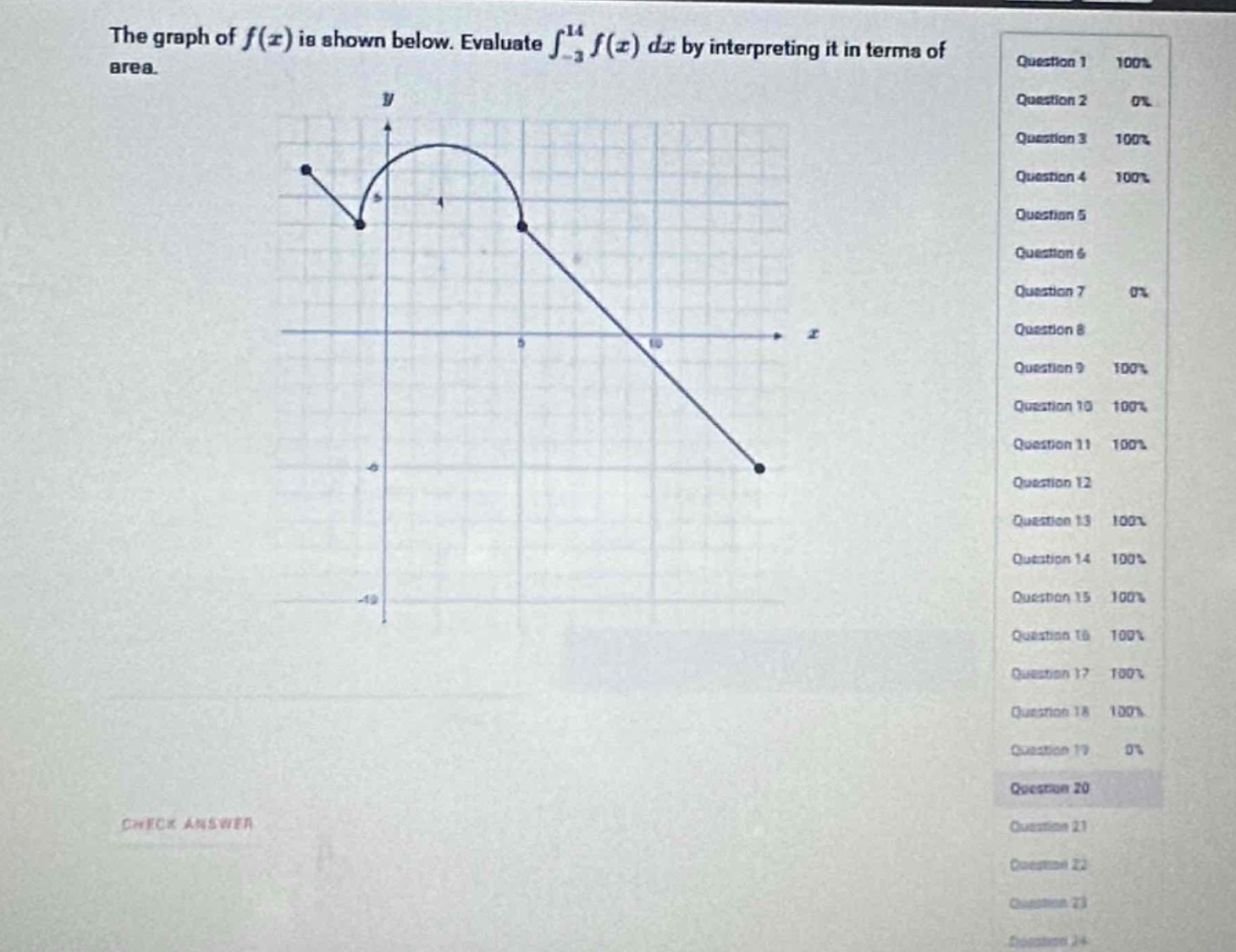
the graph of $f(x)$ is shown below. evaluate $\\int_{-3}^{14} f(x) dx$ by interpreting it in terms of area.
Answer
Explanation:
Step1: Divide the region
Divide the region under the curve from (x = - 3) to (x=14) into geometric - shapes (triangles, rectangles, semi - circles etc.).
Step2: Calculate areas of sub - regions
Find the area of each sub - region. For example, if there is a triangle with base (b) and height (h), its area (A_{triangle}=\frac{1}{2}bh); if there is a semi - circle with radius (r), its area (A_{semicircle}=\frac{1}{2}\pi r^{2}).
Step3: Determine signs of areas
Areas above the (x) - axis contribute positively to the integral, and areas below the (x) - axis contribute negatively.
Step4: Sum up the areas
Add up the areas of all sub - regions with their appropriate signs to get (\int_{-3}^{14}f(x)dx).
Since the graph is not clear enough to provide exact numerical values for base, height, radius etc., the general process is as above. If we assume we have calculated the areas of sub - regions (A_1,A_2,\cdots,A_n) with signs (s_1,s_2,\cdots,s_n) ((s_i = 1) for areas above (x) - axis and (s_i=-1) for areas below (x) - axis), then (\int_{-3}^{14}f(x)dx=\sum_{i = 1}^{n}s_iA_i).
Answer:
The value of (\int_{-3}^{14}f(x)dx) is the sum of the signed areas of the geometric sub - regions under the curve from (x=-3) to (x = 14).