the graph of f is shown in the figure. (a) for which values of x is f(x) zero? (enter your answers as a…
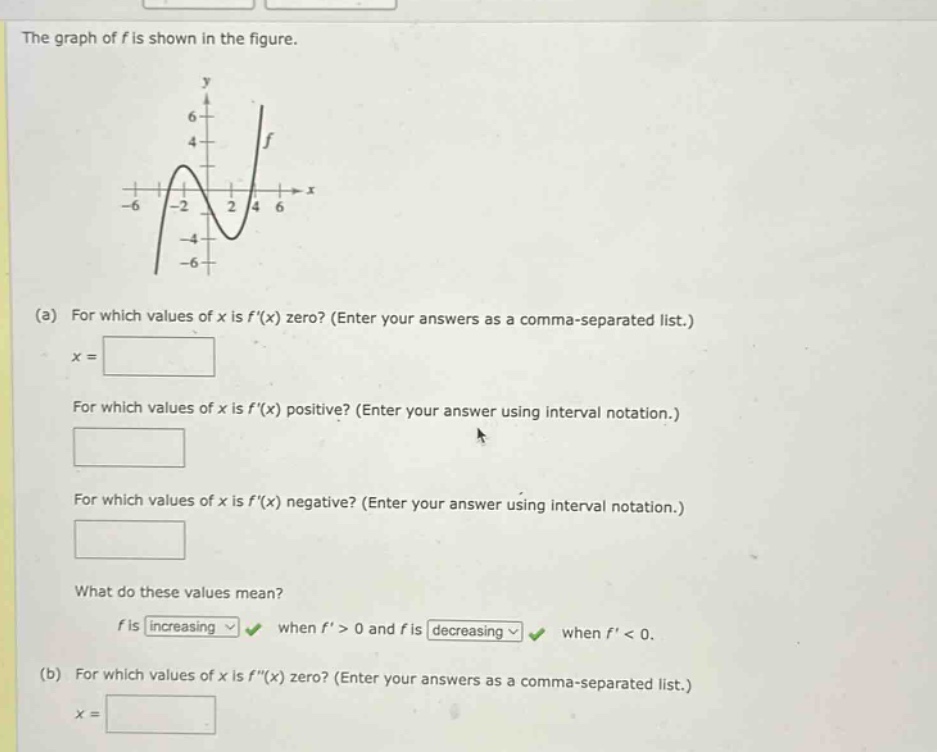
the graph of f is shown in the figure. (a) for which values of x is f(x) zero? (enter your answers as a comma - separated list.) x = for which values of x is f(x) positive? (enter your answer using interval notation.) for which values of x is f(x) negative? (enter your answer using interval notation.) what do these values mean? f is increasing when f > 0 and f is decreasing when f < 0. (b) for which values of x is f(x) zero? (enter your answers as a comma - separated list.) x =
Answer
Explanation:
Step1: Recall derivative - slope relationship
The derivative $f^{\prime}(x)$ is zero where the graph of $y = f(x)$ has a horizontal tangent.
Step2: Identify horizontal - tangent points
From the graph, the function $y = f(x)$ has horizontal tangents at $x=- 2,2$. So for $f^{\prime}(x)=0$, $x=-2,2$.
Step3: Determine where $f^{\prime}(x)>0$
The function $y = f(x)$ is increasing when $f^{\prime}(x)>0$. From the graph, $f(x)$ is increasing on the intervals $(-\infty,-2)$ and $(2,\infty)$.
Step4: Determine where $f^{\prime}(x)<0$
The function $y = f(x)$ is decreasing when $f^{\prime}(x)<0$. From the graph, $f(x)$ is decreasing on the interval $(-2,2)$.
Step5: Recall second - derivative meaning
The second - derivative $f^{\prime\prime}(x)$ is zero where the graph of $y = f(x)$ has an inflection point (where the concavity changes).
Step6: Identify inflection points
From the graph, the inflection points occur at $x = 0$. So for $f^{\prime\prime}(x)=0$, $x = 0$.
Answer:
(a) $x=-2,2$; $(-\infty,-2)\cup(2,\infty)$; $(-2,2)$ (b) $x = 0$