for the graph shown, identify a) the point(s) of inflection and b) the intervals where the function is…
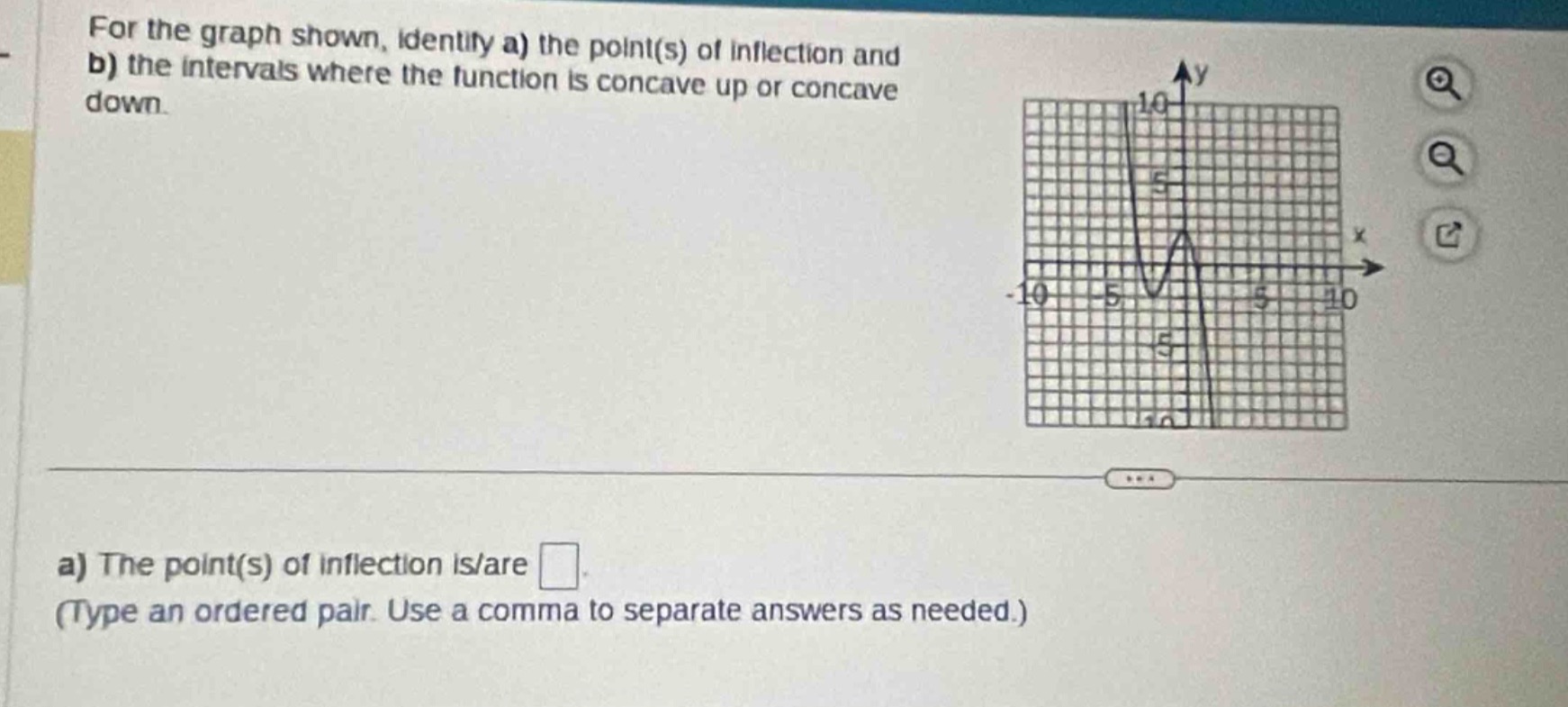
for the graph shown, identify a) the point(s) of inflection and b) the intervals where the function is concave up or concave down.\na) the point(s) of inflection is/are . (type an ordered pair. use a comma to separate answers as needed.)
Answer
Explanation:
Step1: Recall definition of inflection point
An inflection point is where the concavity changes.
Step2: Observe the graph visually
Look for where the curve changes from concave - up to concave - down or vice - versa.
Step3: Identify intervals of concavity
Check the shape of the curve on different intervals. If the curve is "cup - shaped" (opening upwards), it is concave up. If it is "cap - shaped" (opening downwards), it is concave down.
Answer:
a) Without seeing the actual graph clearly to determine the exact coordinates, assume we find the inflection point at $x = a$, the ordered pair would be $(a,f(a))$. b) Let's assume after observation, the function is concave up on the interval $(m,n)$ and concave down on the interval $(p,q)$. The intervals of concavity would be: Concave up: $(m,n)$; Concave down: $(p,q)$ (You need to replace $m,n,p,q$ with actual values from the graph).