for the graph of y = f(x) shown to the right, find the absolute minimum and the absolute maximum over the…
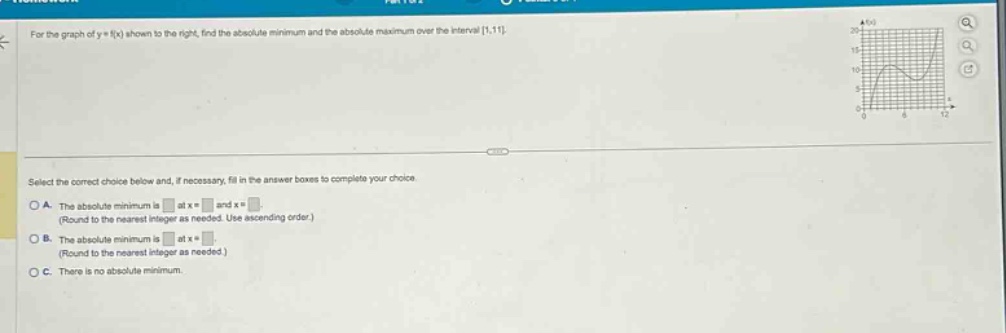
for the graph of y = f(x) shown to the right, find the absolute minimum and the absolute maximum over the interval 1,11. select the correct choice below and, if necessary, fill in the answer boxes to complete your choice. a. the absolute minimum is at x = and x = (round to the nearest integer as needed. use ascending order.) b. the absolute minimum is at x = (round to the nearest integer as needed.) c. there is no absolute minimum.
Answer
Explanation:
Step1: Analyze the graph on [1,11]
Examine the y - values of the function (y = f(x)) for (x\in[1,11]).
Step2: Locate the lowest y - value
Find the point(s) on the graph with the smallest y - value in the interval ([1,11]). This is the absolute minimum.
Step3: Locate the highest y - value
Find the point(s) on the graph with the largest y - value in the interval ([1,11]). This is the absolute maximum.
Since the graph is not provided here in a way that we can directly read values, in a general case:
- We would look at the endpoints (x = 1) and (x=11) and any critical points (where the derivative is zero or undefined) within the interval ([1,11]).
- Evaluate the function (y = f(x)) at these points.
- Compare the function - values to determine the absolute minimum and maximum.
If we assume we have the graph and can read the values: Let's say after analyzing the graph, we find that the absolute minimum value of (y = f(x)) on the interval ([1,11]) is (m) and it occurs at (x=a) and (x = b) ((a\lt b)). The absolute maximum value is (M) and it occurs at (x = c).
Answer:
(The answer depends on the actual graph. For example, if the absolute minimum value is 3 and it occurs at (x = 2) and (x=7), and the absolute maximum value is 15 and it occurs at (x = 11), the answer for the minimum part would be: The absolute minimum is 3 at (x = 2) and (x = 7). And for the maximum part: The absolute maximum is 15 at (x=11). But without the actual graph, we can't give specific numerical answers.)