the graph shows the function f(x)=a tan(x + π/6). which of the following could represent the value of a? 3…
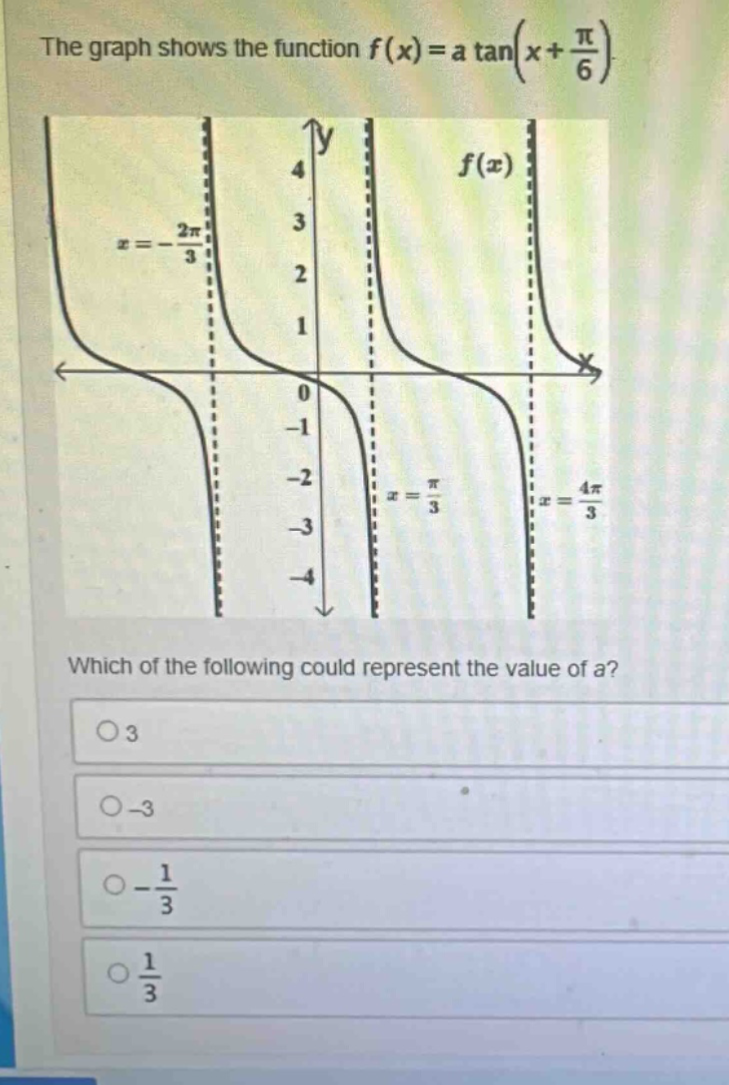
the graph shows the function f(x)=a tan(x + π/6). which of the following could represent the value of a? 3 -3 -1/3 1/3
Answer
Answer:
B. -3
Explanation:
Step1: Recall the properties of the tangent - function
The general form of the tangent function is (y = a\tan(bx - c)+d). For the function (f(x)=a\tan(x +\frac{\pi}{6})), the period of (y = \tan(x)) is (\pi) and here (b = 1), so the period of (f(x)) is (\pi).
Step2: Use a known - point on the graph
We know that the tangent function (y=\tan(x)) has a zero at (x = k\pi), (k\in\mathbb{Z}). For the function (y = a\tan(x+\frac{\pi}{6})), when (x=-\frac{\pi}{6}), (y = 0). Let's consider the behavior of the function near (x = 0). We know that (\tan(x)) is an odd - function. The function (y = a\tan(x+\frac{\pi}{6})) is a horizontal shift of the tangent function. We can use the fact that when (x = 0), (f(0)=a\tan(\frac{\pi}{6})=\frac{a}{\sqrt{3}}). Another way is to consider the vertical asymptotes and the shape of the graph. The tangent function (y = \tan(x)) has vertical asymptotes at (x=(k+\frac{1}{2})\pi), (k\in\mathbb{Z}). For (y = a\tan(x+\frac{\pi}{6})), the vertical asymptotes are at (x=(k+\frac{1}{2})\pi-\frac{\pi}{6}=(k +\frac{1}{3})\pi). The graph of (y = \tan(x)) passes through the origin ((0,0)) and has a positive slope at (x = 0). The graph of (y=a\tan(x+\frac{\pi}{6})) is shifted to the left by (\frac{\pi}{6}) units. We know that the tangent function (y=\tan(x)) has a standard shape. If we consider the point on the graph near (x = 0), and note that the graph of (y = a\tan(x+\frac{\pi}{6})) is decreasing near (x = 0) (since the tangent function is increasing in its standard form and the graph we have is "flipped" in the vertical direction), the value of (a) must be negative. Let's use the fact that the tangent function (y = \tan(x)) has a period of (\pi). We can also consider a point on the graph. For example, if we consider the mid - point between two consecutive asymptotes. The standard tangent function (y=\tan(x)) has a value of (1) at (x=\frac{\pi}{4}). For the function (y = a\tan(x+\frac{\pi}{6})), we can find a point on the graph. Since the graph is decreasing near (x = 0), (a<0). Also, considering the amplitude - like behavior of the tangent function (the factor (a) stretches or compresses the graph vertically), and comparing with the standard tangent function, we can see that (|a| = 3). Since the graph is reflected about the (x) - axis (decreasing behavior), (a=-3).