the graph below shows the functions $f(x)$ and $g(x)$. use the values in the graph to compute the following…
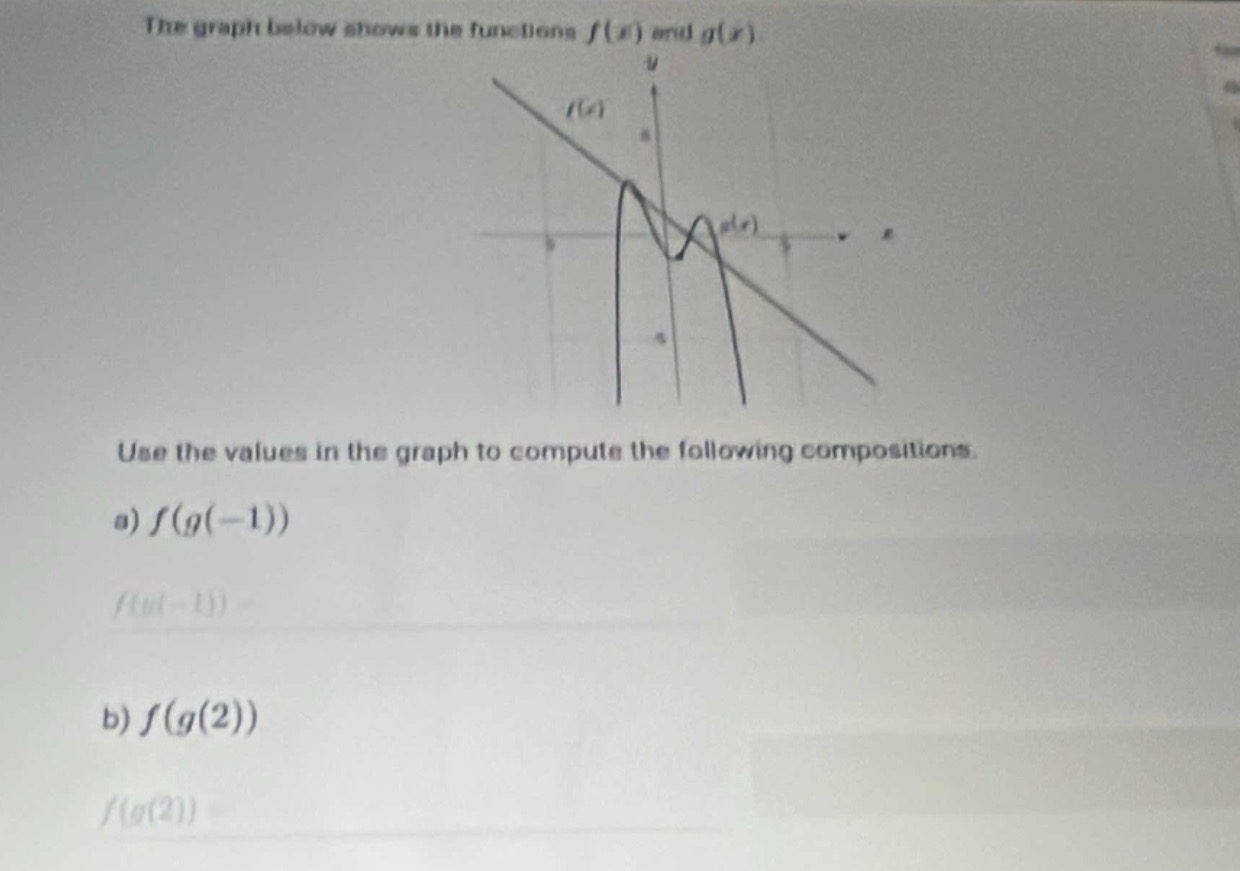
the graph below shows the functions $f(x)$ and $g(x)$. use the values in the graph to compute the following compositions. a) $f(g(-1))$ b) $f(g(2))$
Answer
Explanation:
Step1: Find $g(-1)$ from the graph
Locate $x = - 1$ on the $x$-axis for $g(x)$ and read the $y$-value.
Step2: Use the result of $g(-1)$ as the input for $f(x)$
Plug the $y$-value of $g(-1)$ into $f(x)$ and find the corresponding $y$-value on the $f(x)$ graph.
Step3: Find $g(2)$ from the graph
Locate $x = 2$ on the $x$-axis for $g(x)$ and read the $y$-value.
Step4: Use the result of $g(2)$ as the input for $f(x)$
Plug the $y$-value of $g(2)$ into $f(x)$ and find the corresponding $y$-value on the $f(x)$ graph.
Since the actual graph - values are not provided numerically, we can't give a numerical answer. But the general process for part a) is:
- First, find the value of $g(-1)$ by looking at the graph of $g(x)$ at $x=-1$. Let's say $g(-1)=a$.
- Then, find $f(a)$ by looking at the graph of $f(x)$ at $x = a$. For part b):
- First, find the value of $g(2)$ by looking at the graph of $g(x)$ at $x = 2$. Let's say $g(2)=b$.
- Then, find $f(b)$ by looking at the graph of $f(x)$ at $x = b$.
If we assume we have read the values from the graph: Let $g(-1)=m$ and $g(2)=n$. a) First find $m$ from $g(x)$ graph at $x=-1$, then find $f(m)$ from $f(x)$ graph. b) First find $n$ from $g(x)$ graph at $x = 2$, then find $f(n)$ from $f(x)$ graph.
If we had the actual graph - values:
Answer:
a) <Value of $f(g(-1))$> b) <Value of $f(g(2))$>