the graph below shows a rectangular sum of n = 8 rectangles to approximate the area under the line from x =…
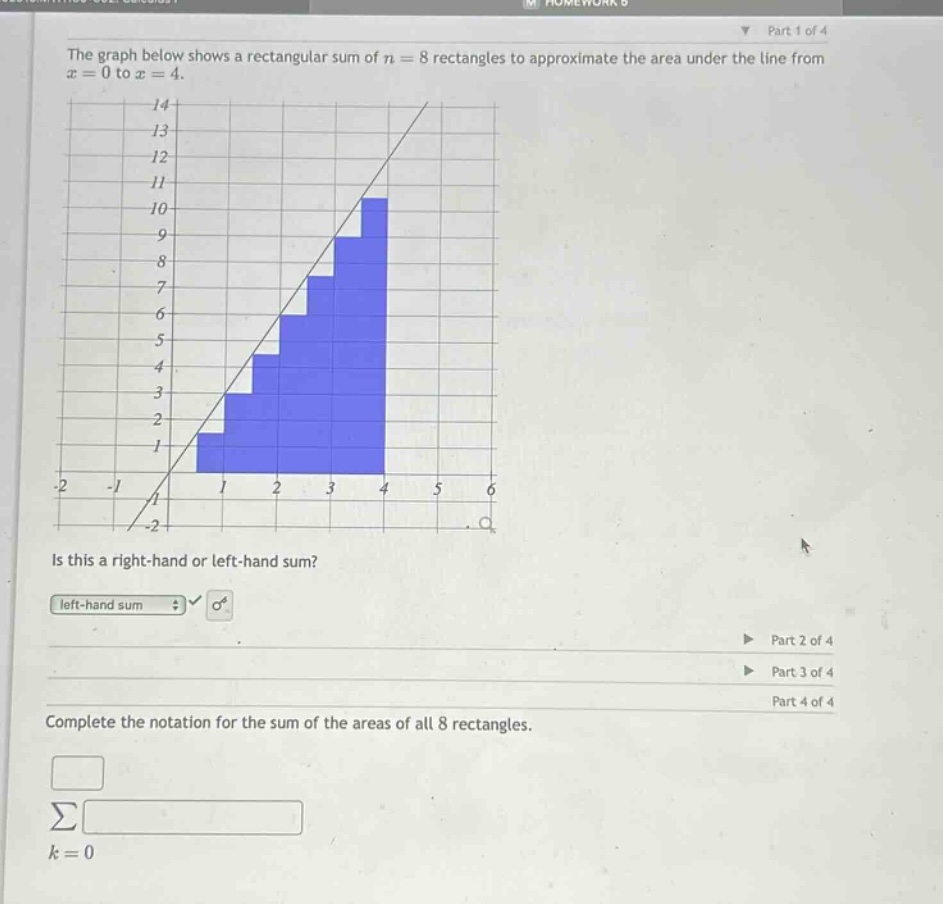
the graph below shows a rectangular sum of n = 8 rectangles to approximate the area under the line from x = 0 to x = 4. is this a right - hand or left - hand sum? left - hand sum complete the notation for the sum of the areas of all 8 rectangles. ∑ k = 0
Answer
Explanation:
Step1: Determine the type of sum
In a left - hand sum, the height of each rectangle is determined by the function value at the left - hand endpoint of the sub - interval. Looking at the graph, the height of each rectangle is based on the function value at the left - hand side of the sub - interval for each rectangle, so it is a left - hand sum.
Step2: Find the width and height of rectangles
The interval is from $x = 0$ to $x=4$ and $n = 8$. The width of each rectangle $\Delta x=\frac{4 - 0}{8}=0.5$. The left - hand endpoints of the sub - intervals are $x_k=0 + k\Delta x=0.5k$ for $k = 0,1,\cdots,7$. If the line is of the form $y = mx + b$, from the graph, when $x = 0,y = 1$ and when $x = 4,y=9$. The slope $m=\frac{9 - 1}{4-0}=2$ and the $y$ - intercept $b = 1$, so the function is $y=2x + 1$. The height of the $k$th rectangle is $f(x_k)=2(0.5k)+1=k + 1$.
Step3: Write the sum notation
The sum of the areas of the rectangles for a left - hand sum is $\sum_{k = 0}^{7}f(x_k)\Delta x$. Since $\Delta x=0.5$ and $f(x_k)=k + 1$, the sum is $\sum_{k = 0}^{7}0.5(k + 1)$.
Answer:
$\sum_{k = 0}^{7}0.5(k + 1)$