5 graph y = sin (2x + π)
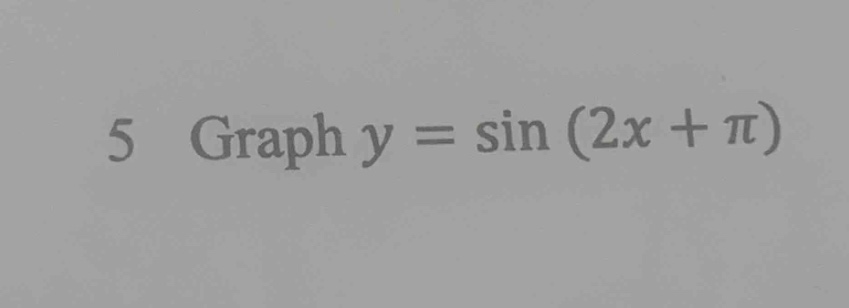
5 graph y = sin (2x + π)
Answer
Explanation:
Step1: Identify the amplitude
The general form of a sine - function is $y = A\sin(Bx - C)+D$. For the function $y=\sin(2x+\pi)$, $A = 1$, so the amplitude is $|A|=1$.
Step2: Find the period
The period of a sine - function $y = \sin(Bx - C)+D$ is given by $T=\frac{2\pi}{|B|}$. Here, $B = 2$, so $T=\frac{2\pi}{2}=\pi$.
Step3: Determine the phase shift
Rewrite $y=\sin(2x+\pi)$ as $y=\sin\left(2\left(x+\frac{\pi}{2}\right)\right)$. The phase shift is $\frac{C}{B}$. Since $C=-\pi$ and $B = 2$, the phase shift is $-\frac{\pi}{2}$ (a shift to the left by $\frac{\pi}{2}$ units).
Step4: Find key points
For the basic sine - function $y = \sin(x)$, key points are $(0,0),(\frac{\pi}{2},1),(\pi,0),(\frac{3\pi}{2}, - 1),(2\pi,0)$. For $y=\sin(2x+\pi)$:
- When $2x+\pi=0$, $x =-\frac{\pi}{2}$ and $y = 0$.
- When $2x+\pi=\frac{\pi}{2}$, $2x=-\frac{\pi}{2}$, $x =-\frac{\pi}{4}$ and $y = 1$.
- When $2x+\pi=\pi$, $2x = 0$, $x = 0$ and $y = 0$.
- When $2x+\pi=\frac{3\pi}{2}$, $2x=\frac{\pi}{2}$, $x=\frac{\pi}{4}$ and $y=-1$.
- When $2x+\pi = 2\pi$, $2x=\pi$, $x=\frac{\pi}{2}$ and $y = 0$. Plot these key - points and draw a smooth sine - curve with amplitude 1 and period $\pi$ shifted to the left by $\frac{\pi}{2}$ units.
Answer:
Graph the function with amplitude 1, period $\pi$, and phase - shift $-\frac{\pi}{2}$ using key points $(-\frac{\pi}{2},0),(-\frac{\pi}{4},1),(0,0),(\frac{\pi}{4}, - 1),(\frac{\pi}{2},0)$ and drawing a smooth sine - curve.