the graph of a sinusoidal function intersects its midline at (0, 5) and then has a maximum point at (π, 6)…
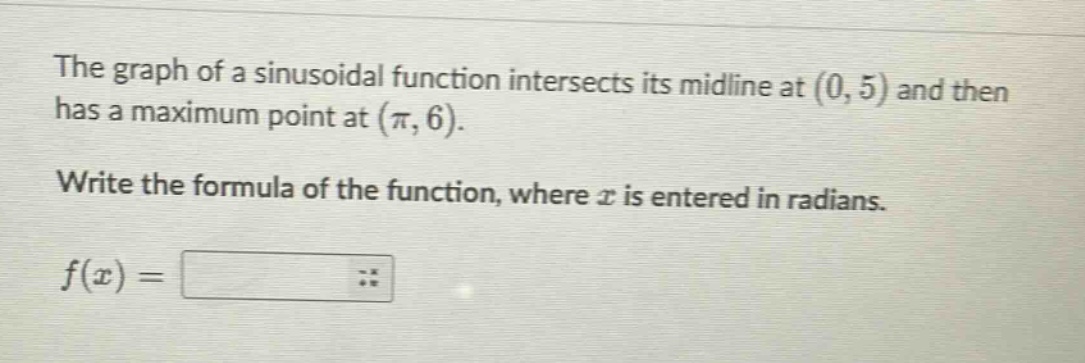
the graph of a sinusoidal function intersects its midline at (0, 5) and then has a maximum point at (π, 6). write the formula of the function, where x is entered in radians. f(x) =
Answer
Explanation:
Step1: Determine the vertical shift
The mid - line of a sinusoidal function is given by $y = k$. Since the function intersects its mid - line at $(0,5)$, then $k = 5$.
Step2: Determine the amplitude
The amplitude $A$ is the distance from the mid - line to the maximum or minimum. The mid - line is $y = 5$ and the maximum is at $y = 6$. So $A=6 - 5=1$.
Step3: Determine the period
The function goes from the mid - line at $x = 0$ to a maximum at $x=\pi$. A quarter of the period $T$ is $\pi-0=\pi$. So the period $T = 4\pi$. Using the formula $T=\frac{2\pi}{B}$, we have $4\pi=\frac{2\pi}{B}$, and solving for $B$ gives $B=\frac{1}{2}$.
Step4: Determine the phase shift
The function intersects the mid - line at $x = 0$, so we can use the form $y=A\sin(Bx)+k$. Substituting $A = 1$, $B=\frac{1}{2}$, and $k = 5$ into the formula, we get $y=\sin(\frac{1}{2}x)+5$.
Answer:
$f(x)=\sin(\frac{1}{2}x)+5$