the graph of a tangent function is given. select the equation for each graph from the following options. y =…
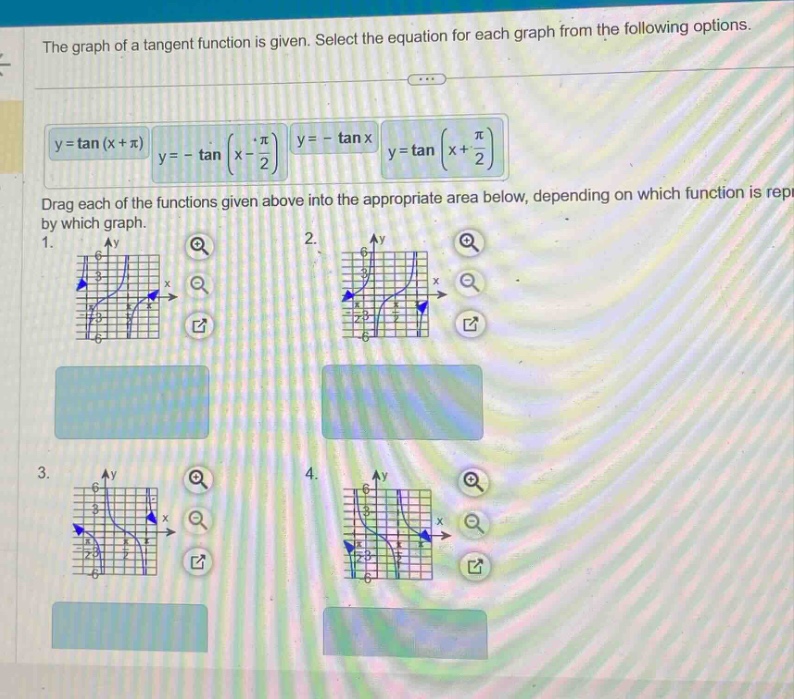
the graph of a tangent function is given. select the equation for each graph from the following options. y = tan(x + π) y = - tan(x - π/2) y = - tan x y = tan(x + π/2) drag each of the functions given above into the appropriate area below, depending on which function is represented by which graph. 1. 2. 3. 4.
Answer
Explanation:
Step1: Recall tangent - function transformation rules
The general form of a tangent - function transformation is (y = A\tan(B(x - C))+D), where (A) is the vertical stretch, (B) affects the period ((T=\frac{\pi}{|B|})), (C) is the horizontal shift, and (D) is the vertical shift. For the tangent function (y = \tan x), its period is (\pi), and it has vertical asymptotes at (x=(n+\frac{1}{2})\pi,n\in\mathbb{Z}), and passes through the origin ((0,0)).
- The function (y = \tan(x+\pi)): Using the rule (y = f(x + c)) is a horizontal shift of the function (y = f(x)) to the left by (c) units. For (y=\tan(x + \pi)), since the period of (y = \tan x) is (\pi), (y=\tan(x+\pi)=\tan x). Its vertical asymptotes are (x=(n+\frac{1}{2})\pi-\pi=(n - \frac{1}{2})\pi,n\in\mathbb{Z}).
- The function (y=-\tan(x-\frac{\pi}{2})): First, (y = f(x - c)) is a horizontal shift of (y = f(x)) to the right by (c) units. So (y=\tan(x-\frac{\pi}{2})) has vertical asymptotes at (x=(n+\frac{1}{2})\pi+\frac{\pi}{2}=(n + 1)\pi,n\in\mathbb{Z}). And the negative sign reflects the graph of (y = \tan(x-\frac{\pi}{2})) about the (x) - axis.
- The function (y=-\tan x): It is a reflection of the graph of (y = \tan x) about the (x) - axis. Its vertical asymptotes are (x=(n+\frac{1}{2})\pi,n\in\mathbb{Z}).
- The function (y=\tan(x+\frac{\pi}{2})): It is a horizontal shift of (y = \tan x) to the left by (\frac{\pi}{2}) units. Its vertical asymptotes are (x=(n+\frac{1}{2})\pi-\frac{\pi}{2}=n\pi,n\in\mathbb{Z}).
Step2: Analyze the graphs
- The graph of (y = \tan(x+\pi)) is the same as the graph of (y=\tan x) (because of the periodicity of the tangent function with period (\pi)). It has vertical asymptotes at (x=(n+\frac{1}{2})\pi,n\in\mathbb{Z}) and passes through the origin.
- The graph of (y =-\tan x) is a reflection of (y = \tan x) about the (x) - axis. It has the same vertical - asymptote positions as (y=\tan x) (i.e., (x=(n+\frac{1}{2})\pi,n\in\mathbb{Z})) but the function values are the opposite of those of (y = \tan x).
- The graph of (y=\tan(x+\frac{\pi}{2})) has vertical asymptotes at (x = n\pi,n\in\mathbb{Z}) (since for (y=\tan u), (u=x+\frac{\pi}{2}), and (u=(n+\frac{1}{2})\pi) gives (x=(n+\frac{1}{2})\pi-\frac{\pi}{2}=n\pi)).
- The graph of (y =-\tan(x - \frac{\pi}{2})) has vertical asymptotes at (x=(n + 1)\pi,n\in\mathbb{Z}) (because for (y=\tan u), (u=x-\frac{\pi}{2}), and (u=(n+\frac{1}{2})\pi) gives (x=(n+\frac{1}{2})\pi+\frac{\pi}{2}=(n + 1)\pi)) and is reflected about the (x) - axis.
Answer:
- (y=\tan(x+\pi))
- (y =-\tan x)
- (y=\tan(x+\frac{\pi}{2}))
- (y=-\tan(x-\frac{\pi}{2}))