2. graph $f(\\theta)=\\sin(\\theta)$\n3. what is the period of $f(\\theta)=\\sin(\\theta)$? how do you…
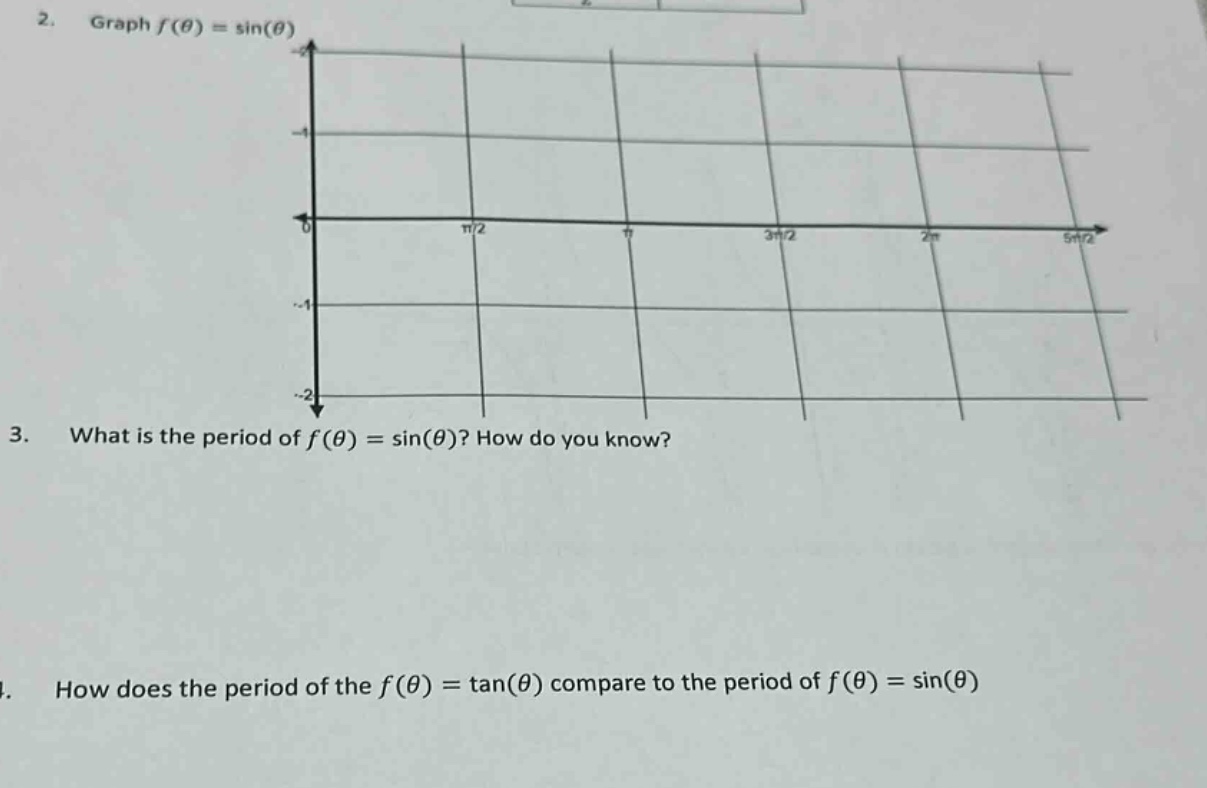
2. graph $f(\\theta)=\\sin(\\theta)$\n3. what is the period of $f(\\theta)=\\sin(\\theta)$? how do you know?\n4. how does the period of the $f(\\theta)=\\tan(\\theta)$ compare to the period of $f(\\theta)=\\sin(\\theta)$
Answer
Explanation:
Step 1: Identify key points for $f(\theta) = \sin(\theta)$
Calculate the value of $\sin(\theta)$ at key angles within one cycle ($0$ to $2\pi$). $f(0) = \sin(0) = 0$ $f(\frac{\pi}{2}) = \sin(\frac{\pi}{2}) = 1$ $f(\pi) = \sin(\pi) = 0$ $f(\frac{3\pi}{2}) = \sin(\frac{3\pi}{2}) = -1$ $f(2\pi) = \sin(2\pi) = 0$ Key points are $(0, 0)$, $(\frac{\pi}{2}, 1)$, $(\pi, 0)$, $(\frac{3\pi}{2}, -1)$, $(2\pi, 0)$.
Step 2: Plot the key points on the graph
Locate the points identified in Step 1 on the provided coordinate system. The x-axis represents $\theta$ and the y-axis represents $f(\theta)$.
Step 3: Draw the sine curve
Connect the plotted points with a smooth, continuous curve. The shape should be wave-like, oscillating between -1 and 1. Extend the pattern as needed for the given axis range (up to $\frac{5\pi}{2}$). $f(\frac{5\pi}{2}) = \sin(\frac{5\pi}{2}) = \sin(\frac{\pi}{2} + 2\pi) = \sin(\frac{\pi}{2}) = 1$. The point is $(\frac{5\pi}{2}, 1)$.
(The graph should be drawn on the provided grid. Since I cannot draw directly, imagine plotting the points $(0, 0)$, $(\frac{\pi}{2}, 1)$, $(\pi, 0)$, $(\frac{3\pi}{2}, -1)$, $(2\pi, 0)$, $(\frac{5\pi}{2}, 1)$ and connecting them with a smooth sine wave.)
Step 4: Determine the period of $f(\theta) = \sin(\theta)$
The period of a function $f(\theta)$ is the smallest positive value $P$ such that $f(\theta + P) = f(\theta)$ for all $\theta$. For $f(\theta) = \sin(\theta)$, the function repeats its values every $2\pi$ radians. $\sin(\theta + 2\pi) = \sin(\theta)$ The period is $2\pi$. This is known from the definition of the sine function based on the unit circle, where a full rotation corresponds to $2\pi$ radians. The graph visually confirms this as one complete cycle occurs over the interval $[0, 2\pi]$.
Step 5: Determine the period of $f(\theta) = \tan(\theta)$
The period of the tangent function, $f(\theta) = \tan(\theta)$, is the smallest positive value $P$ such that $\tan(\theta + P) = \tan(\theta)$ for all $\theta$ in its domain. $\tan(\theta + \pi) = \tan(\theta)$ The period of $\tan(\theta)$ is $\pi$.
Step 6: Compare the periods
Compare the period of $\tan(\theta)$ found in Step 5 with the period of $\sin(\theta)$ found in Step 4. Period of $\sin(\theta) = 2\pi$ Period of $\tan(\theta) = \pi$ The period of $f(\theta) = \tan(\theta)$ is $\pi$, which is half the period of $f(\theta) = \sin(\theta)$, which is $2\pi$.
Answer:
- The graph of $f(\theta) = \sin(\theta)$ is a smooth curve passing through points $(0, 0)$, $(\frac{\pi}{2}, 1)$, $(\pi, 0)$, $(\frac{3\pi}{2}, -1)$, $(2\pi, 0)$, $(\frac{5\pi}{2}, 1)$, oscillating between $y=-1$ and $y=1$. (Graph drawing required on the image).
- The period of $f(\theta) = \sin(\theta)$ is $2\pi$. We know this because the sine function completes one full cycle of its values as the angle $\theta$ increases by $2\pi$ radians, which corresponds to one full rotation around the unit circle.
- The period of $f(\theta) = \tan(\theta)$ is $\pi$, while the period of $f(\theta) = \sin(\theta)$ is $2\pi$. The period of the tangent function is half the period of the sine function.