below is the graph of y = e^x. transform it to make the graph of y = e^(x + 6)+2. give the domain and range…
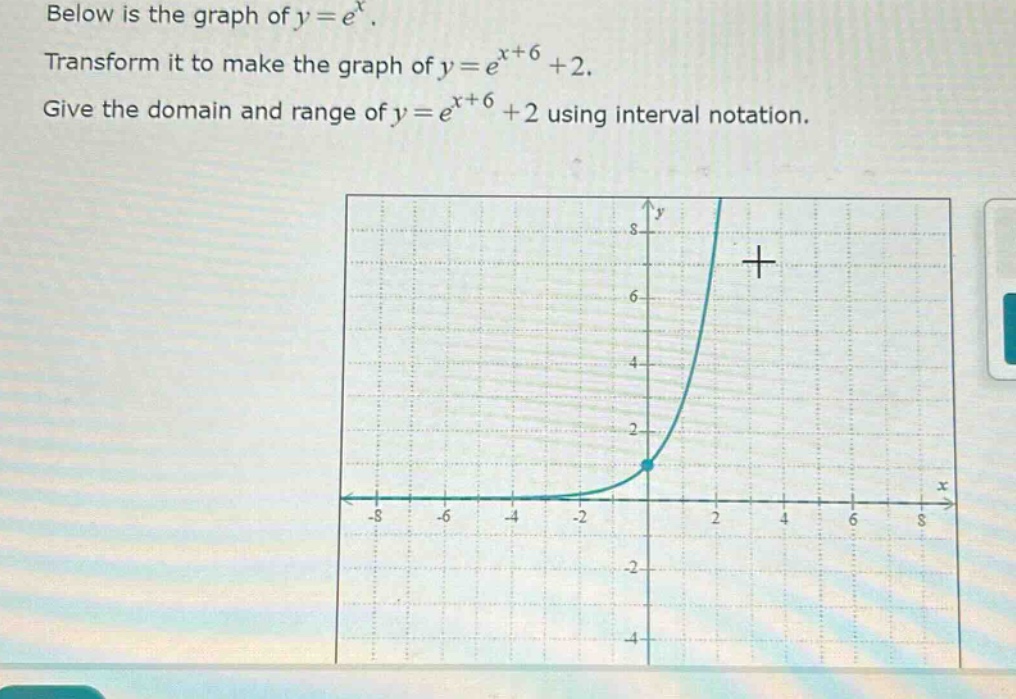
below is the graph of y = e^x. transform it to make the graph of y = e^(x + 6)+2. give the domain and range of y = e^(x + 6)+2 using interval notation.
Answer
Explanation:
Step1: Recall transformation rules
For the function $y = f(x)$, $y=f(x + h)$ is a horizontal - shift and $y=f(x)+k$ is a vertical - shift. For $y = e^{x+6}+2$, compared to $y = e^{x}$, the graph of $y = e^{x}$ is shifted 6 units to the left (because of $x+6$) and 2 units up (because of + 2).
Step2: Find the domain
The exponential function $y = e^{x+6}+2$ is defined for all real - values of $x$. So the domain of $y = e^{x+6}+2$ is the set of all real numbers. In interval notation, the domain is $(-\infty,\infty)$.
Step3: Find the range
The range of the basic exponential function $y = e^{x}$ is $(0,\infty)$. When we transform $y = e^{x}$ to $y = e^{x+6}+2$, the vertical shift of 2 units up changes the range. The new range is obtained by adding 2 to each value in the range of $y = e^{x}$. So the range of $y = e^{x+6}+2$ is $(2,\infty)$.
Answer:
Domain: $(-\infty,\infty)$ Range: $(2,\infty)$