below is the graph of y = e^x. transform it to make the graph of y = e^(-x) - 5. give the range and domain…
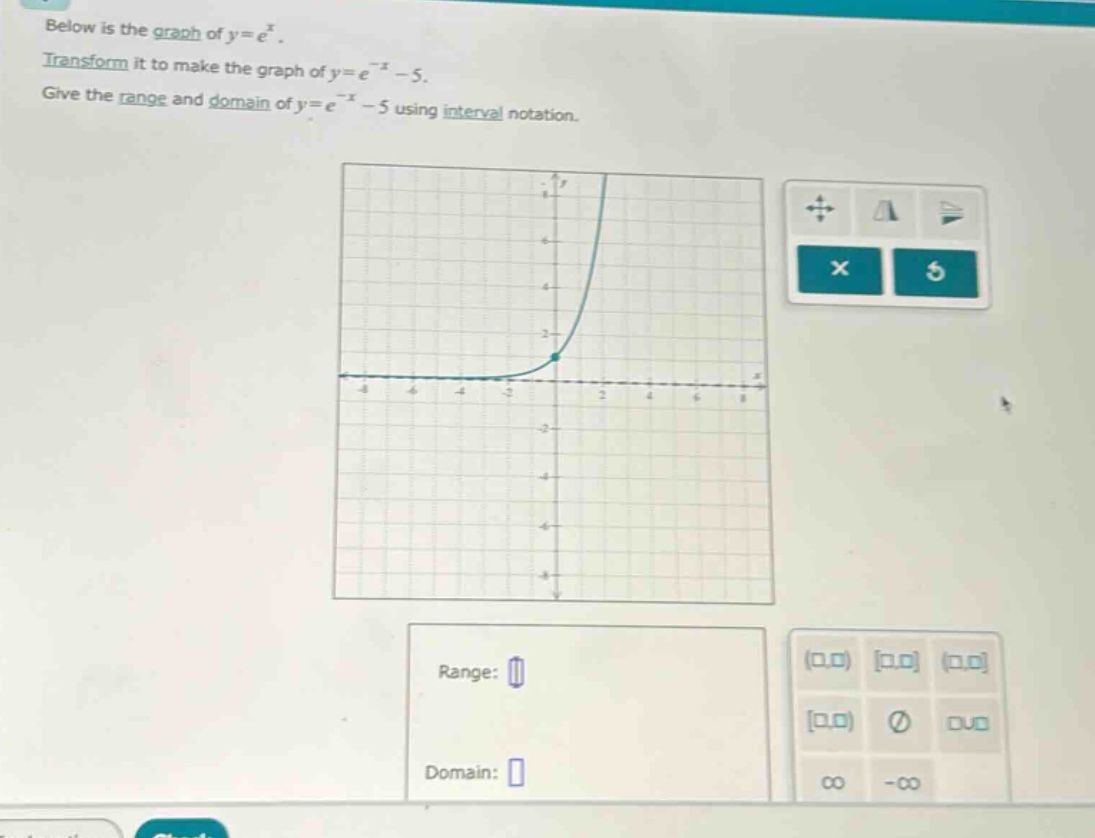
below is the graph of y = e^x. transform it to make the graph of y = e^(-x) - 5. give the range and domain of y = e^(-x) - 5 using interval notation.
Answer
Explanation:
Step1: Identify the base function and transformations.
The base function is $y = e^x$. The target function is $y = e^{-x} - 5$. This involves two transformations: reflection across the y-axis ($x \to -x$) and a vertical shift downwards by 5 units ($-5$).
Step2: Determine the domain of the transformed function.
The domain of the base function $y = e^x$ is all real numbers, $(-\infty, \infty)$. Reflecting across the y-axis ($y = e^{-x}$) does not change the domain. Shifting the graph vertically ($y = e^{-x} - 5$) also does not change the domain. $$ \text{Domain} = (-\infty, \infty) $$
Step3: Determine the range of the transformed function.
The range of the base function $y = e^x$ is $(0, \infty)$. Reflecting across the y-axis ($y = e^{-x}$) does not change the range. Shifting the graph down by 5 units ($y = e^{-x} - 5$) shifts the range down by 5 units. The new range is $(0-5, \infty-5)$. $$ \text{Range} = (-5, \infty) $$
Answer:
Range: $(-5, \infty)$ Domain: $(-\infty, \infty)$