the graph of y = e^x is transformed as shown in the graph below. which equation represents the transformed…
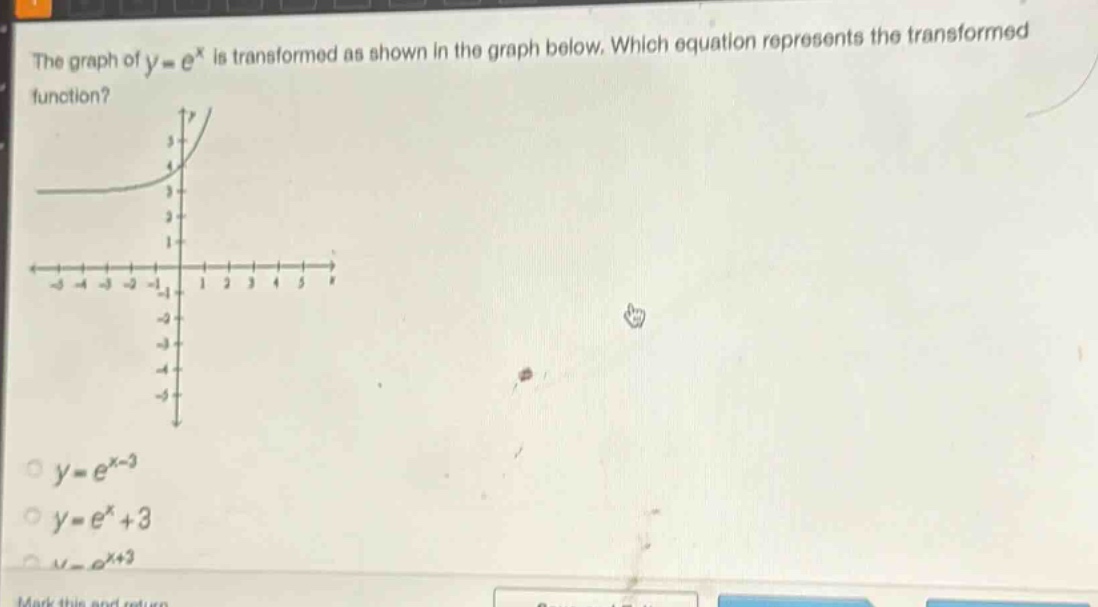
the graph of y = e^x is transformed as shown in the graph below. which equation represents the transformed function? y = e^(x - 3) y = e^x + 3 y = e^(x + 3)
Answer
Explanation:
Step1: Recall function - transformation rules
For the exponential function $y = e^{x}$, a vertical shift of $k$ units is given by $y=e^{x}+k$ (upward if $k>0$ and downward if $k < 0$), and a horizontal shift of $h$ units is given by $y = e^{x - h}$ (right - ward if $h>0$ and left - ward if $h < 0$).
Step2: Analyze the y - intercept
The original function $y = e^{x}$ has a y - intercept at $(0,1)$ since when $x = 0$, $y=e^{0}=1$. In the transformed graph, the y - intercept is at $(0,4)$. This indicates a vertical shift of 3 units upward. The general form of a vertical shift of the function $y = f(x)$ is $y=f(x)+k$. For $y = e^{x}$, the transformed function is $y = e^{x}+3$.
Answer:
$y = e^{x}+3$