graph the trigonometric function.\n\n$y = 2sin(x+\frac{pi}{3})$ \n\nplot all points corresponding to…
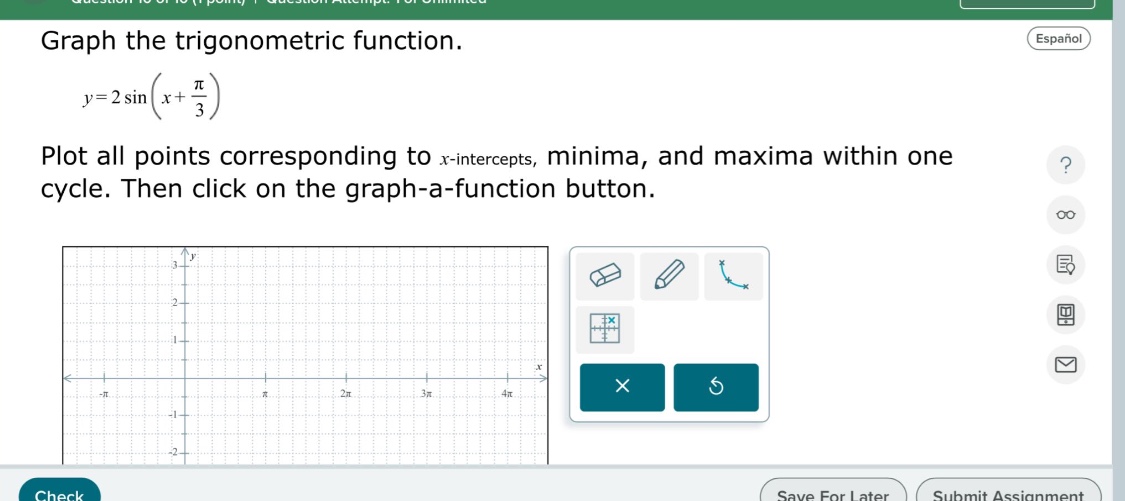
graph the trigonometric function.\n\n$y = 2sin(x+\frac{pi}{3})$ \n\nplot all points corresponding to $x$-intercepts, minima, and maxima within one cycle. then click on the graph - a - function button.
Answer
Explanation:
Step1: Identify the general form
The general form of a sine - function is $y = A\sin(Bx - C)+D$. For the function $y = 2\sin(x+\frac{\pi}{3})$, we have $A = 2$, $B = 1$, $C=-\frac{\pi}{3}$, and $D = 0$. The period $T$ of the sine - function is given by $T=\frac{2\pi}{B}$. Since $B = 1$, the period $T = 2\pi$.
Step2: Find the x - intercepts
Set $y = 0$. Then $2\sin(x+\frac{\pi}{3})=0$, which means $\sin(x+\frac{\pi}{3})=0$. We know that $\sin\theta=0$ when $\theta = k\pi,k\in\mathbb{Z}$. So $x+\frac{\pi}{3}=k\pi$, and $x=k\pi-\frac{\pi}{3}$. For one - cycle ($0\leq x\leq2\pi$), when $k = 1$, $x=\pi-\frac{\pi}{3}=\frac{2\pi}{3}$; when $k = 2$, $x = 2\pi-\frac{\pi}{3}=\frac{5\pi}{3}$.
Step3: Find the maxima
The maximum value of the sine function $\sin\theta$ is 1. We set $\sin(x+\frac{\pi}{3}) = 1$. Then $x+\frac{\pi}{3}=\frac{\pi}{2}+2k\pi,k\in\mathbb{Z}$. Solving for $x$, we get $x=\frac{\pi}{2}-\frac{\pi}{3}=\frac{\pi}{6}+2k\pi$. For one - cycle ($0\leq x\leq2\pi$), when $k = 0$, $x=\frac{\pi}{6}$, and $y = 2\times1=2$.
Step4: Find the minima
The minimum value of the sine function $\sin\theta$ is - 1. We set $\sin(x+\frac{\pi}{3})=-1$. Then $x+\frac{\pi}{3}=\frac{3\pi}{2}+2k\pi,k\in\mathbb{Z}$. Solving for $x$, we get $x=\frac{3\pi}{2}-\frac{\pi}{3}=\frac{7\pi}{6}+2k\pi$. For one - cycle ($0\leq x\leq2\pi$), when $k = 0$, $x=\frac{7\pi}{6}$, and $y = 2\times(-1)=-2$.
To graph the function:
- Plot the x - intercepts $(\frac{2\pi}{3},0)$ and $(\frac{5\pi}{3},0)$.
- Plot the maximum point $(\frac{\pi}{6},2)$.
- Plot the minimum point $(\frac{7\pi}{6},-2)$.
- Then connect these points with a smooth curve to form one - cycle of the sine function $y = 2\sin(x+\frac{\pi}{3})$.
Answer:
Plot the points $(\frac{\pi}{6},2),(\frac{2\pi}{3},0),(\frac{7\pi}{6},-2),(\frac{5\pi}{3},0)$ and connect them with a smooth curve for one - cycle of the function.