graph the trigonometric function. y = cosx + 2 plot all points corresponding to minima and maxima within one…
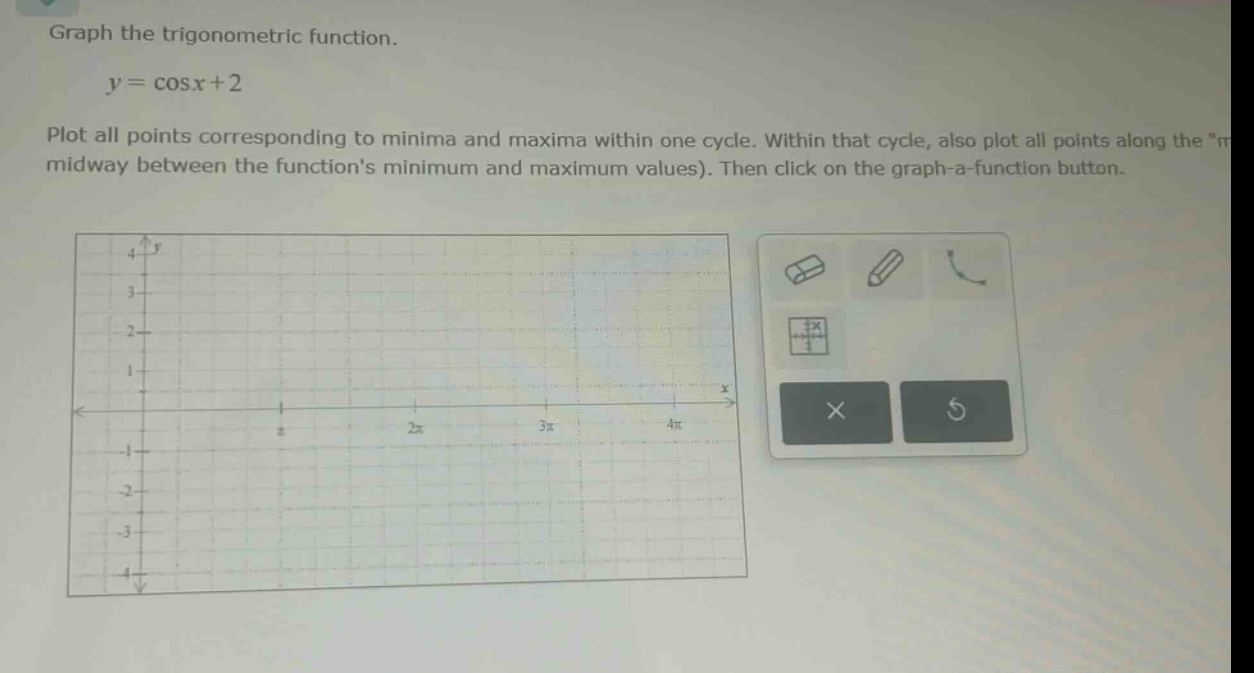
graph the trigonometric function. y = cosx + 2 plot all points corresponding to minima and maxima within one cycle. within that cycle, also plot all points along the \midway between the functions minimum and maximum values). then click on the graph - a - function button.
Answer
Explanation:
Step1: Recall properties of cosine function
The standard cosine - function is $y = \cos x$ with a period of $2\pi$, a maximum value of $1$ when $x = 2k\pi,k\in\mathbb{Z}$ and a minimum value of - 1 when $x=(2k + 1)\pi,k\in\mathbb{Z}$.
Step2: Analyze the given function $y=\cos x + 2$
The transformation $y = f(x)+c$ shifts the graph of $y = f(x)$ vertically by $c$ units. For $y=\cos x+2$, the maximum value of $\cos x$ is 1, so the maximum of $y=\cos x + 2$ is $1 + 2=3$. This occurs when $\cos x = 1$, i.e., $x = 2k\pi,k\in\mathbb{Z}$. In the interval $[0,2\pi]$, the maximum point is $(0,3)$ and $(2\pi,3)$. The minimum value of $\cos x$ is - 1, so the minimum of $y=\cos x + 2$ is $-1 + 2 = 1$. This occurs when $\cos x=-1$, i.e., $x=(2k + 1)\pi,k\in\mathbb{Z}$. In the interval $[0,2\pi]$, the minimum point is $(\pi,1)$. The mid - value between the maximum and minimum of $y=\cos x + 2$ is $\frac{3 + 1}{2}=2$. For $y=\cos x+2 = 2$, we have $\cos x=0$. So $x=\frac{\pi}{2}+k\pi,k\in\mathbb{Z}$. In the interval $[0,2\pi]$, the points are $(\frac{\pi}{2},2)$ and $(\frac{3\pi}{2},2)$.
To graph the function $y=\cos x + 2$:
- Plot the maximum points $(0,3)$ and $(2\pi,3)$.
- Plot the minimum point $(\pi,1)$.
- Plot the mid - points $(\frac{\pi}{2},2)$ and $(\frac{3\pi}{2},2)$.
- Sketch the cosine - like curve passing through these points with a period of $2\pi$.
Answer:
Plot the points $(0,3),(\frac{\pi}{2},2),(\pi,1),(\frac{3\pi}{2},2),(2\pi,3)$ and sketch a cosine - like curve with period $2\pi$ passing through them.