graph the trigonometric function. y = 1/2 csc(2/3 x) start by drawing three consecutive asymptotes. then…
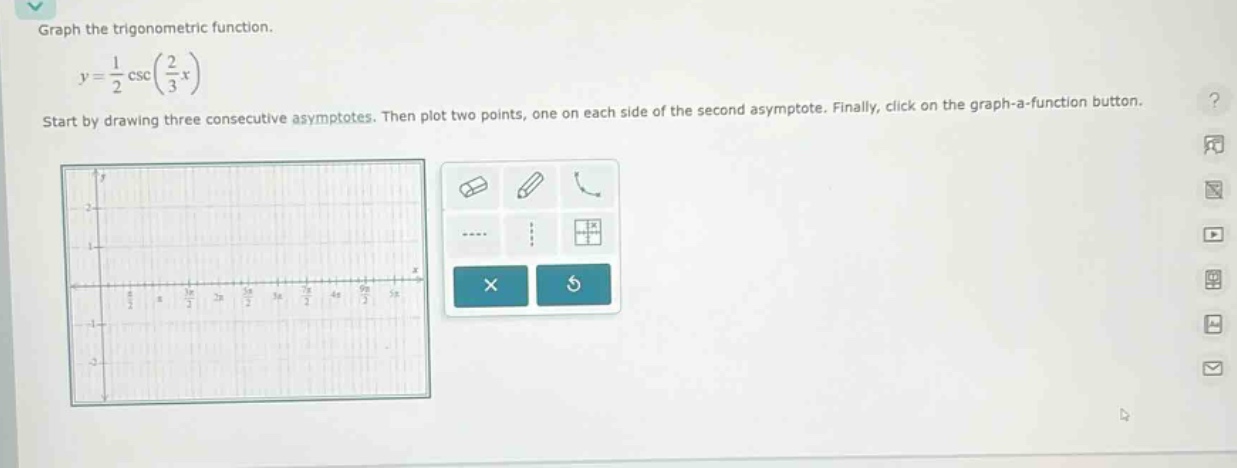
graph the trigonometric function. y = 1/2 csc(2/3 x) start by drawing three consecutive asymptotes. then plot two points, one on each side of the second asymptote. finally, click on the graph - a - function button.
Answer
Explanation:
Step1: Recall csc - sine relationship
The cosecant function $y = \frac{1}{2}\csc(\frac{2}{3}x)$ is related to the sine function $y=\sin(u)$ where $u = \frac{2}{3}x$. The asymptotes of $y = A\csc(Bx)$ occur where $\sin(Bx)=0$.
Step2: Find the period of the sine - related function
The period of $y=\sin(Bx)$ is $T=\frac{2\pi}{B}$. For $y = \sin(\frac{2}{3}x)$, $B=\frac{2}{3}$, so $T=\frac{2\pi}{\frac{2}{3}}=3\pi$.
Step3: Determine the asymptotes
The sine function $\sin(\frac{2}{3}x)=0$ when $\frac{2}{3}x = k\pi$, $k\in\mathbb{Z}$. Solving for $x$ gives $x=\frac{3}{2}k\pi$. Three consecutive asymptotes can be found by taking $k = 0,1,2$. So the asymptotes are $x = 0,x=\frac{3\pi}{2},x = 3\pi$.
Step4: Find points around the second asymptote
The second asymptote is $x=\frac{3\pi}{2}$. Let's find points on either side. When $x=\frac{3\pi}{2}-\frac{3\pi}{4}=\frac{3\pi}{4}$, $y=\frac{1}{2}\csc(\frac{2}{3}\times\frac{3\pi}{4})=\frac{1}{2}\csc(\frac{\pi}{2})=\frac{1}{2}\times1=\frac{1}{2}$. When $x=\frac{3\pi}{2}+\frac{3\pi}{4}=\frac{9\pi}{4}$, $y=\frac{1}{2}\csc(\frac{2}{3}\times\frac{9\pi}{4})=\frac{1}{2}\csc(\frac{3\pi}{2})=\frac{1}{2}\times(- 1)=-\frac{1}{2}$.
To graph: Draw the asymptotes $x = 0,x=\frac{3\pi}{2},x = 3\pi$. Plot the points $(\frac{3\pi}{4},\frac{1}{2})$ and $(\frac{9\pi}{4},-\frac{1}{2})$ and then sketch the graph of the cosecant function with amplitude $\frac{1}{2}$ and period $3\pi$ using the properties of the cosecant function (it has U - shaped curves between the asymptotes).
Answer:
Graph the asymptotes $x = 0,x=\frac{3\pi}{2},x = 3\pi$, plot the points $(\frac{3\pi}{4},\frac{1}{2})$ and $(\frac{9\pi}{4},-\frac{1}{2})$ and sketch the cosecant - shaped curves.